
TL;DR

Get furniture and decor delivered free with Prime
- Fast, free delivery on millions of items
- Prime Video, Amazon Music and more included
- Member-only deals all year
A Livingetc first-person report describes how growing dozens of orchids changed the writer’s approach to plant care and decorating. The writer shares four care suggestions, including checking root color before watering and providing cooler nights for Phalaenopsis orchids to encourage a new flower spike.
Livingetc has published a first-person account by a houseplant enthusiast who says growing dozens of orchids taught her to value patience, close observation and restraint. The writer, who says she now keeps about 60 houseplants, most of them orchids, also outlines four care practices she uses to encourage indoor orchids to grow and flower again.
The writer says her collection once reached an estimated 300 to 400 plants, but caring for that many in a 1930s semi-detached home became demanding. She later reduced the collection by asking whether each plant brought her joy, writing that orchids were the plants she kept without needing to apply that test. She describes her current approach as more minimalist, while noting that her home still contains roughly 60 plants.
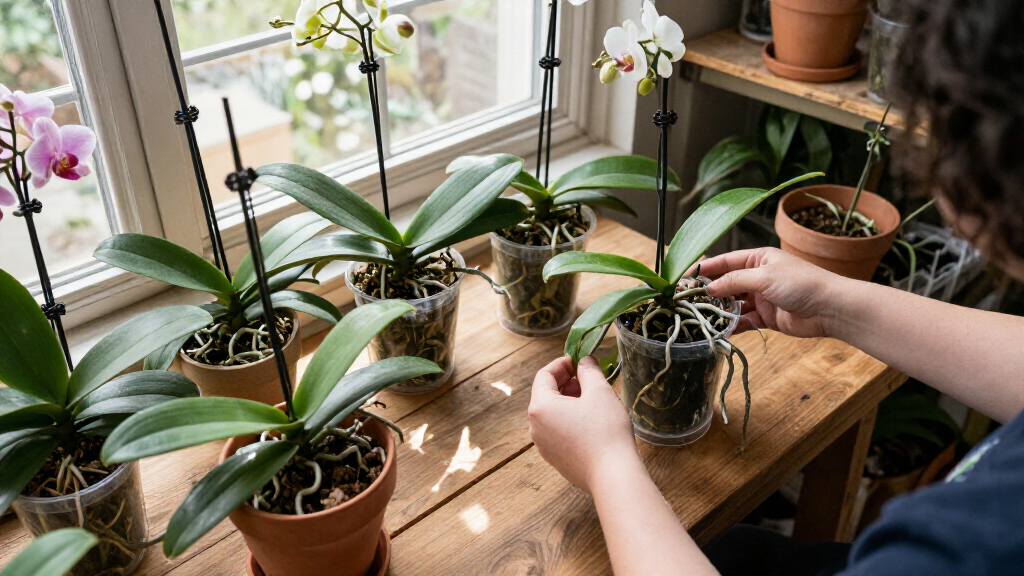
In the Livingetc report, she recommends placing orchids in a bright spot, usually a windowsill that receives a few hours of direct sun each day. Her second suggestion is to water when the roots change from green to silvery gray. She advises using orchid fertilizer at one-quarter of the recommended dosage once or twice a month.
The fourth practice concerns temperature. The writer says Phalaenopsis orchids may need a slight decrease in nighttime temperatures to encourage a new flower spike. She points to windowsills, particularly in autumn, as a place where cooler nights can provide that change. These are the writer’s recommendations in a personal home-care report, not a guarantee that every orchid will rebloom under the same conditions.
The Value of Waiting for Rebloom
The report’s central point is that orchid care rewards observation over quick results. Rather than treating a spent flower spike as the end of a plant’s display, the writer says she enjoys waiting for an orchid to flower again and seeing that process as a result of continued care. That perspective may help readers approach an inexpensive but often short-lived houseplant purchase as a longer-term commitment.
Her experience also links plant care with decisions about the home. She argues that a room does not need to be filled with plants to feel considered, and suggests choosing a suitable display spot and a decorative pot. In her account, the benefit is both practical and visual: fewer plants can be easier to care for, while giving each one more space and attention.
The advice is useful to readers who have kept an orchid after its blooms faded, but the article does not provide a controlled test of its methods or compare different orchid species. Its value is as a first-person account with practical tips, rather than an independently evaluated horticultural study.
Products Worth Considering

Philips Hue Festavia 130-Foot Indoor/Outdoor Smart String Lights, 500 Mini Color-Changing LEDs

Philips Hue Smart Light Starter Kit with Bridge and 4 White and Color A19 Bulbs

Dyson Big Ball Multi Floor Canister Vacuum, Yellow
As an affiliate, we earn on qualifying purchases.
From a Crowded Collection to Orchids
The writer describes a gradual shift from collecting houseplants to keeping a smaller selection. At the high point of her collection, she estimates that she had between 300 and 400 plants and says she believed there could never be too many. The demands of maintaining an indoor collection changed that view, prompting her to keep plants that continued to matter to her.
Orchids remained a favorite through that downsizing. The writer says their color, form and detail are part of their appeal, but emphasizes watching them grow as the greater reward. The source also identifies Sarah Gerrard-Jones as the author of Love Your Orchid: An Inspirational Guide to Keep Your Plants Blooming, a DK Books title described as a new autumn 2026 release and available now.
The report pairs the care discussion with advice on display. It recommends allowing a single orchid room to stand out on a windowsill and suggests looking for decorative pots at charity, vintage and antique shops. Those suggestions reflect the writer’s own preferences, rather than a requirement for successful orchid care.
“I will never understand the people who throw an orchid away after it flowers. They’re missing the best part: the wait.”
— The Livingetc writer
Limits of the Care Advice
The article does not specify the exact orchid varieties in the writer’s collection beyond mentioning Phalaenopsis, nor does it give a fixed temperature range, watering schedule or seasonal timeline for reblooming. It also does not report controlled trials or expert review of the four recommendations. Orchid needs can vary, so the advice should be understood as the writer’s account of what she does, not a promise of results.
The source describes a slight nighttime temperature drop as something that can help Phalaenopsis produce a new flower spike, but it does not quantify that drop or explain how readers should manage temperature in homes where window conditions vary. The timing and availability details for the cited DK book are presented in the source, but no separate publication details are provided in the supplied material.
Watching for the Next Flower Spike
The writer’s proposed next step is continued, attentive care: keep orchids in a bright position, check root color before watering, feed sparingly and observe nighttime conditions, especially as autumn brings cooler evenings. Readers following the approach can watch for changes in roots and new growth rather than expecting an immediate bloom.
The Livingetc account does not announce a follow-up test, new care guidance or a specific date by which the orchids should flower. The next development for any individual plant will depend on its condition and growing environment; the report presents patience as part of the process, not a set timetable.
Key Questions
What did the Livingetc writer say orchids taught her?
She says caring for dozens of orchids taught her patience, observation and restraint, both in plant care and in how she approaches decorating her home.
How many houseplants does the writer keep now?
She says she has about 60 houseplants, most of them orchids. She estimates her collection once reached between 300 and 400 plants.
When does the writer recommend watering an orchid?
Her advice is to water when the orchid’s roots change from green to silvery gray. The report does not give a fixed watering interval.
What does the report say can encourage a Phalaenopsis to flower again?
The writer says a slight drop in nighttime temperature may encourage a new flower spike. She notes that cooler autumn nights near a window can provide that change, but does not specify a temperature range or guarantee reblooming.
Does the article establish that these care steps work for every orchid?
No. It is a first-person report, and its advice is not presented as a controlled study or universal guarantee. The source does not detail the needs of every orchid type.
Source: livingetc.com