
TL;DR
Joanna Gaines’ renovations of Cottonland Castle feature Calacatta marble slab backsplashes in the kitchen and butler’s pantry. The design offers a grout-free alternative to subway tile, though marble typically costs more and requires care; exact project costs and maintenance details were not provided.
Joanna Gaines used Calacatta marble slabs as backsplashes in the kitchen and butler’s pantry of Cottonland Castle, presenting a more continuous, grout-free alternative to familiar white subway tile. The design feature highlights marble’s historic use and visual staying power, while acknowledging that a stone slab backsplash comes with a higher upfront investment.

Get furniture and decor delivered free with Prime
- Fast, free delivery on millions of items
- Prime Video, Amazon Music and more included
- Member-only deals all year
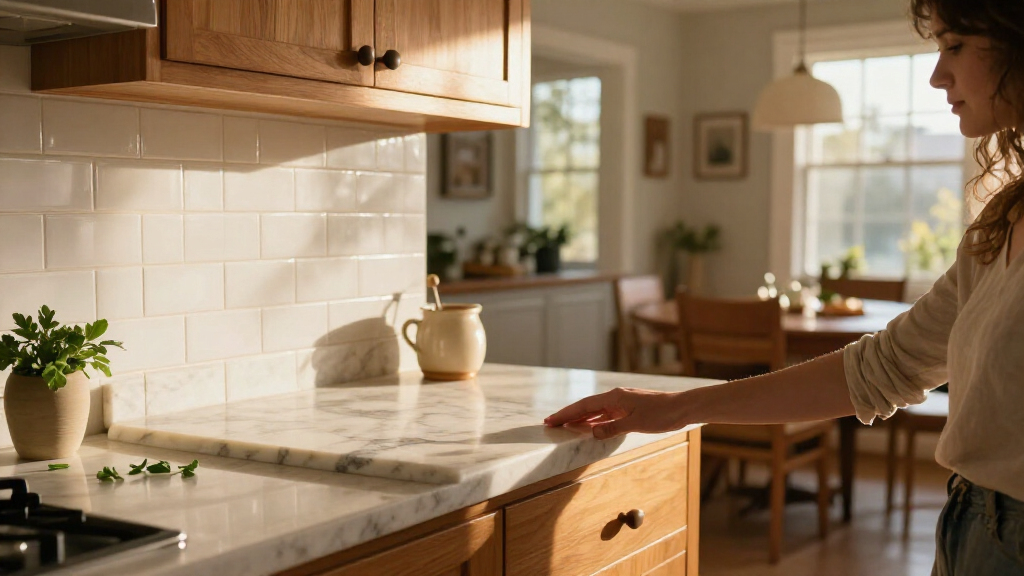
Cottonland Castle is a 1913 landmark in Waco, Texas, renovated by Gaines and her husband, Chip, for the television series Fixer Upper: The Castle. In the home’s kitchen and butler’s pantry, the marble backsplash rises partway up the wall from the countertops. In the kitchen, a marble ledge with brass rails and brackets adds a functional detail to the stone surface.
The design report also points to Gaines’ backsplash design work on the Fixer Upper: The Lakehouse, where she used marble in a midcentury kitchen. There, the backsplash projects outward to form a waterfall-style ledge, combining a continuous stone appearance with a surface that can be used for storage. The two examples show different ways a slab can shape the working area above a counter.
Unlike a backsplash made from individual tiles, a slab has no grout lines across its main surface, offering an alternative to traditional backsplash designs. That can make routine wiping simpler, though the report does not provide details about the stone’s sealing, cleaning products, or long-term maintenance in either home. It also gives no project cost, dimensions, or installation specifications.
A grout-free backsplash in natural marble
Joanna Gaines used Calacatta marble slabs at Cottonland Castle. The continuous stone surface offers a different look from subway tile, with higher upfront cost and care needs to consider.
Two homes, two layouts
The examples show how marble can shape the working area above a counter.
- Slab backsplashes in the kitchen and butler’s pantry
- Kitchen ledge with brass rails and brackets
- Midcentury kitchen with marble backsplash
- Stone projects outward into a waterfall-style ledge
What changes with a slab
A broad stone surface creates a more continuous appearance than individual tiles.
Fewer grout lines
The main slab surface has no grout joints, which may make routine wiping simpler.
Distinctive veining
Each installation has its own natural pattern rather than a uniform tile look.
Useful ledges
The castle kitchen’s brass-railed ledge adds a functional detail to the stone.
Compare the trade-offs
| Choice | What the report says | What remains unclear |
|---|---|---|
| Marble slab | Higher upfront investment; continuous surface | Project cost, sealing, care schedule |
| Subway tile | Traditional, with a broad range of prices and styles | No direct price or upkeep comparison |
A Costlier, More Continuous Backsplash
For homeowners choosing kitchen finishes, the examples make a distinction between initial price and long-term design. Marble is generally among the more expensive natural-stone options, according to the design report, so it is not a direct budget substitute for basic tile. The report argues that a durable, classic-looking surface may remain appealing longer and reduce the likelihood of replacing a trend-led backsplash, but it offers no cost comparison or evidence that marble will save money over a particular period.
The practical case is narrower but clear: a slab avoids grout joints, which can simplify wiping the backsplash surface. The broader appeal comes from the combination of natural stone, fewer visual interruptions, and tailored details such as the castle kitchen’s brass-railed ledge. Those choices can help a renovation feel distinctive without relying on a highly patterned tile. Marble’s distinctive veining also means each installation has its own appearance, rather than the uniform look often associated with standard white subway tile.
That does not make marble the right choice for every kitchen. Homeowners need to weigh the upfront expense and the care requirements of natural stone against tile’s broader range of prices and styles. The feature presents marble as a lasting design option, not as a guarantee that a backsplash will never need maintenance or eventually be changed.
Products Worth Considering

Shark HydroVac MessMaster Cordless Wet Dry Vacuum and Mop Combo, AW261

Dyson V8 Cordless Vacuum

Roborock F25 GT Gen 2 Cordless Wet-Dry Vacuum Mop
As an affiliate, we earn on qualifying purchases.
From Castle Kitchen to Lakehouse
The Cottonland Castle renovation provides a period setting for the marble choice. The property dates to 1913, and the report describes the slabs as a way to give the kitchen and butler’s pantry an elevated finish while retaining a connection to a historic home. Marble has been used in buildings for centuries, including in ancient Greek and Roman architecture; that history is the basis for the feature’s argument that it can feel both traditional and current.
Gaines’ Lakehouse kitchen illustrates a different application of the same material. Rather than stopping at a conventional vertical backsplash, the stone extends outward into a waterfall ledge. Together, the projects show that the design idea is not limited to one historic property or one arrangement, although the examples are not presented as a broad survey of current renovation choices.
““a solid slab Calacatta marble backsplash””
— The design report
Costs and Care Remain Unspecified
The feature does not state what the castle or Lakehouse installations cost, how much marble was used, or whether the slabs were sealed. It also provides no direct comparison of installation costs, upkeep, or lifespan between marble and subway tile. The claim that marble’s longer appeal can offset its price is a design judgment, not a measured financial finding.
Marble is natural stone, and its suitability depends on the specific material, installation, and household use. The report does not identify a particular care schedule or address how the surfaces respond to stains, etching, or other wear. It also does not establish whether Gaines recommended this material for homeowners generally; the projects are examples of her design choices.
Compare Stone, Tile, and Maintenance
No new renovation announcement or follow-up project is identified. For readers considering a similar backsplash, the next step is to compare material and installation quotes, ask stone suppliers and qualified installers about care and sealing for the specific marble, and inspect full slabs where possible to understand their veining. Natural-stone alternatives may cost less than marble, but the report does not name particular products or provide prices.
Homeowners can also compare those estimates with tile options, including the cost of grout installation and upkeep. The examples at Cottonland Castle and the Lakehouse show possible layouts; they do not establish a universal recommendation. The decision will depend on the budget, the desired look, and the maintenance needs of the selected surface.
Source: rss
Key Questions
What backsplash material did Joanna Gaines use at Cottonland Castle?
Gaines used Calacatta marble slabs in the kitchen and butler’s pantry of the Waco home, extending the stone upward from the countertops.
How is a marble slab backsplash different from subway tile?
A slab forms a broad, continuous surface rather than a pattern of individual tiles. It has no grout lines across the main backsplash, which may make wiping the surface simpler; the report does not compare overall maintenance costs.
Is marble cheaper than white subway tile?
The design report describes marble as a higher-investment option and generally near the expensive end of natural stone. It gives no specific prices or direct cost comparison with subway tile.
What feature did Gaines add to the castle kitchen backsplash?
The kitchen backsplash includes a marble ledge fitted with brass rails and brackets. In the Lakehouse kitchen, a projecting marble backsplash creates a waterfall-style ledge instead.
Does the report say marble will never go out of style?
No. It presents marble’s long architectural history as a reason it may have lasting appeal, but future design preferences cannot be guaranteed. The feature provides no forecast or measured evidence about how long a particular installation will remain in place.
Source: hunker.com