TL;DR
Apartment Therapy’s House Tour of Angelie Xiong’s New York apartment highlights narrow, vertically arranged peel-and-stick tiles in a red kitchen and green bathroom. The project shows one renter’s approach to adding color, including mounting the kitchen backsplash tiles on PVC boards over an uneven existing surface; durability and removal results are not reported.
Apartment Therapy’s latest home tour spotlights renter Angelie Xiong’s use of narrow, vertical peel-and-stick tiles to add color to her New York City kitchen and bathroom. The makeover offers a practical example of a temporary-looking design approach, including a custom mounting method for applying the kitchen tiles over an uneven existing backsplash.

Get furniture and decor delivered free with Prime
- Fast, free delivery on millions of items
- Prime Video, Amazon Music and more included
- Member-only deals all year
Xiong’s kitchen had what she described as a “boring millennial gray” look before she decided to change it. She paired red peel-and-stick tiles in Mirah’s “Cinnamon” shade with cabinets painted Behr’s “Moroccan Ruby,” creating a coordinated color scheme. In the bathroom, she chose deep green tiles alongside walls painted Behr’s “Scallion.”
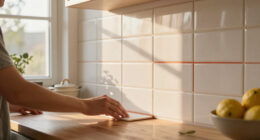
The kitchen installation needed extra preparation because the existing backsplash was uneven. According to the home tour, Xiong considered thin, heat-resistant metal sheets but found them too expensive, while wood boards were too thick. She instead glued the tiles to PVC boards and then attached those boards over the existing backsplash. The account describes this as a renter-friendly workaround, but does not provide technical testing or details about how it performs over time.
The tour’s writer says she has noticed narrow, vertically positioned peel-and-stick tile appearing in multiple makeovers she has covered. An Amazon seller offers the style in 30 colors, according to the article. That availability may help explain its appeal to people seeking a repeatable tile shape with a broader choice of color, though the article does not provide sales figures or data establishing how widely the style is being used.
A renter’s colorful tile refresh with limits to consider
Angelie Xiong used vertical peel-and-stick tiles to add color to her New York kitchen and bathroom. Her project shows one approach, not proof that it works for every home.
Color across two rooms
The tile colors coordinated with painted finishes in each room.
Cinnamon red
Mirah’s “Cinnamon” tiles paired with Behr’s “Moroccan Ruby” cabinets.
Deep green
Green tiles complemented walls painted Behr’s “Scallion.”
How the kitchen was installed
The existing backsplash was uneven, so Xiong used a mounting workaround.
Metal sheets were too expensive; wood boards were too thick.
She glued the tiles to PVC boards, then attached the boards over the backsplash.
What this example can tell you
The makeover is one renter’s design and installation account, not a product test or market survey.
- Vertical, narrow tiles in two rooms
- A PVC-board approach for an uneven backsplash
- A writer’s observation of the style in several makeovers
- Long-term durability or removal results
- Suitability for every surface or kitchen
- How widely the style is used
A Color Update Without Full Renovation
The makeover illustrates why renters and homeowners looking for a less involved update may consider peel-and-stick tile: it can bring a strong color change to a room without describing a full tile replacement. Xiong’s use of one style in two rooms also shows how color and placement can make the same basic format feel different: the kitchen’s red tiles reinforce the cabinets, while the bathroom’s green tiles sit against similarly colored walls.
There are limits to what this example establishes. The home tour records one person’s design choices and installation workaround; it does not establish that peel-and-stick tiles are suitable for every surface, kitchen condition or rental agreement. Readers considering a similar project would need to check product instructions and the condition of the surface, and confirm what their landlord permits. The practical takeaway is not that the material works everywhere, but that surface preparation and installation choices matter.
Products Worth Considering

Google Nest Thermostat E Smart Thermostat with Temperature Sensor Bundle – White

Levoit Core 300S-P Smart WiFi Air Purifier

Levoit Core 400S-P Smart Air Purifier for Large Rooms
As an affiliate, we earn on qualifying purchases.
From Gray Finishes to Bold Color
Xiong said she lived with the gray-and-white kitchen for almost a year before deciding to make a change because she expected a makeover to require too much work. The home tour traces her shift from that neutral starting point to a kitchen with red cabinetry and a matching tile accent, as well as a bathroom refreshed with green. These details give the tile choice a clear role in a broader color update rather than presenting it as an isolated product recommendation.
Apartment Therapy’s writer frames the vertical layout as a fresh take on familiar subway tile and says she has seen the approach recur in kitchen makeovers she has written about over the past three years. That is the writer’s observation, not a market survey. The article notes that peel-and-stick tiles are not new and points to color variety as one reason the format can suit different rooms. It does not name a release date for the products or document a measurable rise in use.
“This was a boring millennial gray kitchen before.”
— Angelie Xiong, speaking during the Apartment Therapy House Tour
How the Installation Holds Up
The home tour does not report how long the tiles have been installed, whether they have lifted or shifted, or how easily they can be removed without damaging the underlying surface. It also does not give product specifications, installation instructions, or independent evidence about heat, moisture or long-term durability. Xiong’s PVC-board method is described for her uneven backsplash, but the article does not establish that it is appropriate for other kitchens or products.
Nor does the writer’s observation that the style appears in several projects confirm a broad design trend. The article provides no sales data, survey results or comparable measure of popularity. The extent to which the tiles are genuinely renter-friendly will depend on the product, the wall or backsplash, the installation method and any lease requirements.
Check the Surface Before Installing
The article does not announce a new product, a scheduled follow-up or a formal trend report. Readers interested in trying the look can use Xiong’s project as a design reference, then check the specific tile maker’s surface and installation guidance before buying. Renters should also review their lease and ask their landlord before attaching panels or adhesive to existing finishes.
Any further assessment of how well this approach works would require information not included in the home tour, such as longer-term performance and removal results. For now, the confirmed development is a published apartment makeover that documents one renter’s use of vertical peel-and-stick tiles in two rooms—not proof that the solution suits every home.
Source: rss
Key Questions
What kind of peel-and-stick tile did Angelie Xiong use?
The home tour describes narrow tiles arranged vertically. Xiong used Mirah’s “Cinnamon” shade in the kitchen and deep green tiles in the bathroom.
How did she cover the uneven kitchen backsplash?
After considering metal sheets and wood boards, Xiong glued the tiles to PVC boards and attached the boards over the existing backsplash, according to the home tour.
Is peel-and-stick tile guaranteed to be renter-friendly?
No such guarantee is established by this example. The article calls the approach renter-friendly, but does not report removal results or confirm that it works on all surfaces. Check product instructions and get landlord approval where required.
Does the article prove vertical peel-and-stick tile is a major trend?
No. The writer says she has noticed the style in several makeovers, but the article offers no sales figures or market-wide data to measure its popularity.
Source: apartmenttherapy.com