
TL;DR

Get furniture and decor delivered free with Prime
- Fast, free delivery on millions of items
- Prime Video, Amazon Music and more included
- Member-only deals all year
A Hunker report recommends soaking a mineral-clogged showerhead in a citric acid solution as an alternative to vinegar. It gives a two-tablespoon-to-two-cups mixing ratio and advises against using the solution on aluminum, copper or brass; the article’s cleaning advice is not a new plumbing standard or a reported study.
Hunker has published a showerhead-cleaning guide recommending a citric acid soak to dissolve mineral scale that can obstruct spray holes and reduce water flow. The report describes citric acid as an alternative to vinegar, while warning that the solution can corrode aluminum, copper and brass fixtures.
The guide’s suggested mixture is two tablespoons of citric acid powder in two cups of water. Hunker says a showerhead can be immersed in the solution for about one to two hours, then rinsed and scrubbed. The article presents citric acid as a stronger descaling option than vinegar and notes that its powdered form lets users adjust the amount mixed into water. Those are the report’s recommendations; it does not cite comparative test results or a study measuring cleaning performance.
For a removable or handheld showerhead, Hunker describes soaking it in a plastic, ceramic or glass bowl or bucket. For a fixed head, the report suggests filling a plastic bag with the solution, positioning it so the spray holes remain submerged, and securing it with rubber bands. The article cautions against mixing the solution in metal cookware because it may react with aluminum or other metals and cause discoloration.
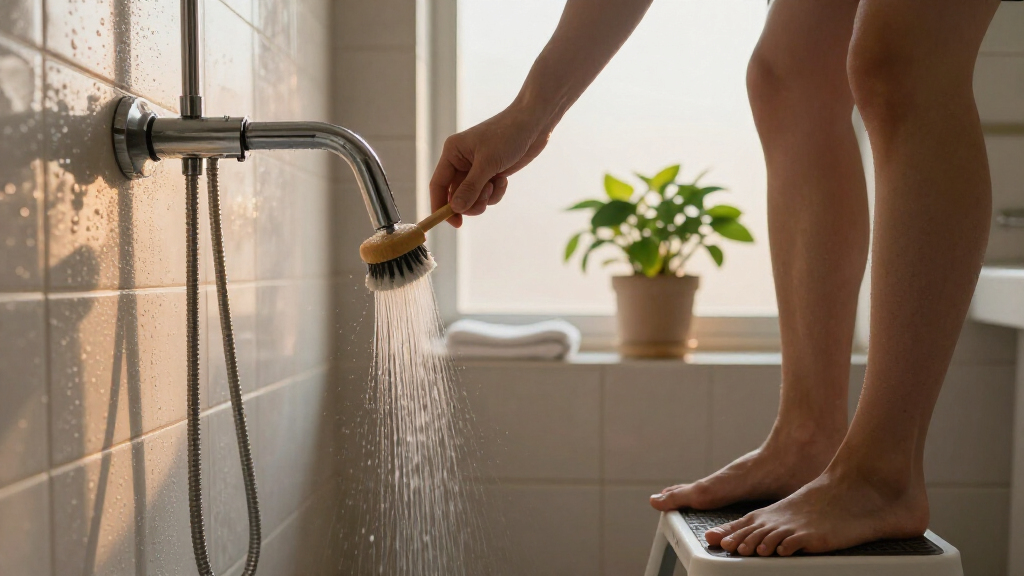
After soaking, the report recommends a final rinse and scrub. It says mineral deposits may not be the only reason holes are blocked: debris can remain after scale dissolves. Hunker therefore suggests clearing stubborn openings with a toothpick. Its instructions do not say that every case of low water pressure comes from showerhead scale, or that cleaning will fix a plumbing problem elsewhere in the system.
A Low-Cost Fix for Mineral Buildup
Mineral deposits can narrow or block showerhead openings, leaving water to spray unevenly or in reduced streams. Hunker argues that this can frustrate users and may lead them to leave the shower running longer. The report does not provide water-use measurements, so it does not establish that a citric acid soak will reduce household water consumption; its direct claim is that cleaning scale may restore a more consistent spray.
The practical value of the recommendation is its straightforward method and its warnings about materials. A household can try a measured soak rather than replacing a clogged head, but the solution is not suitable for every fixture. Checking the showerhead’s material and manufacturer instructions matters, particularly for metal finishes that could be damaged by acid.
As an affiliate, we earn on qualifying purchases.
How the Soaking Method Works
Scale forms when dissolved minerals in water accumulate on surfaces as water passes through and evaporates. The Hunker report focuses on this buildup as one possible cause of restricted spray, not as a diagnosis for all pressure problems. A pressure change affecting several fixtures, for example, is outside the cleaning guide’s scope and may have a different cause.
Vinegar is commonly used for household descaling, but Hunker presents powdered citric acid as an alternative that can be mixed at a chosen concentration and without vinegar’s strong smell. The report says citric acid powder is readily available and inexpensive in North America, and notes that it is a common cleaning product in Japan. It does not provide a sourced market survey or independent price comparison in the supplied material.
““To clean the showerhead, just let it soak in a citric acid solution.””
— Hunker report
What the Cleaning Guide Does Not Establish
The supplied report does not give a publication date, identify a plumbing or materials expert, or cite controlled tests comparing citric acid with vinegar. Its claim that citric acid is stronger and works well for descaling is presented as household guidance, not as independently verified performance data. The suggested one-to-two-hour soak is also a general instruction, not a guarantee that every showerhead will clear in that period.
It remains unclear whether the method is appropriate for every coating, finish, seal or manufacturer-specific fixture design. The article names aluminum, copper and brass as materials to avoid but does not list every possible alloy or finish. Nor does it establish that scale is responsible for an individual reader’s low pressure. If cleaning does not restore flow, or if pressure is low throughout the home, the cause may require a separate assessment.
Check Materials Before Soaking
Readers following the report’s advice should first identify the showerhead material and review any care instructions from its manufacturer. If the fixture is aluminum, copper or brass, Hunker says not to use the citric acid mixture. For other materials, the guide describes soaking in a nonmetal container or using a bag on a fixed showerhead, followed by rinsing, scrubbing and checking for remaining debris.
The report does not announce a follow-up test or further reporting. Whether the cleaning works will depend on the cause and extent of the blockage, and the source provides no outcome data from users. Persistent low flow after cleaning should not automatically be attributed to mineral deposits; the supplied article offers no diagnosis for broader plumbing issues.
Key Questions
What mixture does Hunker recommend?
The report suggests mixing two tablespoons of citric acid powder with two cups of water, then soaking the showerhead for about one to two hours.
Can I use citric acid on any showerhead?
No. Hunker warns against using the solution on showerheads made of aluminum, copper or brass because it can cause corrosion. The report does not list every finish or material, so check the fixture’s care instructions before soaking.
What if my showerhead cannot be removed?
Hunker describes filling a plastic bag with the solution, positioning it so the showerhead’s spray holes are submerged, and securing it around the shower arm with rubber bands. The guide also recommends rinsing and scrubbing afterward.
Will citric acid fix every drop in water pressure?
No such result is established in the report. The method is intended for mineral scale in showerhead openings; it does not diagnose other causes of low flow, and Hunker provides no evidence that all pressure problems will improve after cleaning.
Source: rss
Halloween Picks
halloween
As an affiliate, we earn on qualifying purchases.