For most homes with hardwood floors, I’d start with the Roborock Qrevo S Pro as the best overall choice, balancing vacuuming and mopping with an automated dock. The Roborock Qrevo 2 Pro stands out for buyers who want stronger stated suction, while the Shark AV2501AE is a notable option for those prioritizing a HEPA self-empty base and vacuum-only cleaning. The main tradeoffs are how much automation you need, whether mopping adds value, and how much maintenance you are willing to handle. A higher suction figure alone does not guarantee better hardwood care: brush design, navigation, and a mop that suits your floor finish matter too. Read on for my full comparison of all 15 models and guidance on choosing the right fit for your home.

Get furniture and decor delivered free with Prime
- Fast, free delivery on millions of items
- Prime Video, Amazon Music and more included
- Member-only deals all year
Complete the kit



Key Takeaways
- The Roborock Qrevo S Pro leads as the most balanced choice: its vacuum-and-mop format and automated dock make it a stronger all-round fit than simpler models, though buyers should check the dock’s footprint and care requirements.
- The Qrevo 2 Pro’s stated 20,000 Pa suction sets it apart on paper, not by itself on floor safety or cleaning results: brush design, navigation, and mop control still matter for hardwood.
- Self-emptying models divide the field more than headline suction does: picks such as the Shark AV2501AE and Roborock Q10 S5+ suit people who want fewer bin trips, while compact or basic models keep the setup simpler.
- Mopping is not automatically an advantage on every wood floor: vacuum-only options like the Shark AV2501AE and iRobot Roomba 105 may fit households that want to avoid introducing moisture.
- The lineup spans sharply different levels of automation: premium docked Roborock models prioritize convenience, while the ILIFE V2 and Lefant M210 make more sense for buyers who want a basic routine and fewer system features.
| Roborock Qrevo S Pro Robot Vacuum and Mop |  | Best All-in-One Dock for Mixed Floors | Suction power: 18,500 Pa | Battery life: Up to 180 minutes | Navigation: LiDAR | VIEW LATEST PRICE | See Our Full Breakdown |
| Shark AV2501AE AI Robot Vacuum with XL HEPA Self-Empty Base |  | Best for Hardwood-First Vacuuming | Model: AV2501AE | Navigation: 360° LiDAR with Matrix Clean Navigation | Runtime: Up to 120 minutes | VIEW LATEST PRICE | See Our Full Breakdown |
| Roborock Qrevo 2 Pro Robot Vacuum and Mop with 20,000 Pa Suction |  | Best Premium Pick for Hair and Edge Cleaning | Suction: 20,000 Pa | Battery life: Up to 253 minutes | Navigation: Quick mapping with customizable 3D map and obstacle avoidance | VIEW LATEST PRICE | See Our Full Breakdown |
| Tikom L8000 Plus Robot Vacuum and Mop with Self-Emptying Base |  | Best Value for Multi-Room Mapping | Maximum suction: 6,000 Pa | Dustbag capacity: 3 L | Navigation: 360° LiDAR | VIEW LATEST PRICE | See Our Full Breakdown |
| ROPVACNIC Robot S1 Vacuum and Mop Combo |  | Best Simple Combo for Hardwood and Low-Pile Rugs | Suction power: 5,200 Pa | Battery life: Up to 120 minutes | Surface compatibility: Hardwood floors and low-pile carpets | VIEW LATEST PRICE | See Our Full Breakdown |
| ILIFE A30s Robot Vacuum – 10,000 Pa Max Suction, White |  | Best for Pet Hair on Mixed Floors | Maximum suction: 10,000 Pa | Dustbin capacity: 500 ml | Runtime: Up to 150 minutes | VIEW LATEST PRICE | See Our Full Breakdown |
| Lefant M210 Robot Vacuum Cleaner with App and Voice Control |  | Best Slim Pick for Furniture Clearance | Model: M210 | Dimensions: 11-inch diameter; 2.99-inch height | Runtime: Up to 120 minutes in low-suction mode | VIEW LATEST PRICE | See Our Full Breakdown |
| Roborock Q10 S5+ Robot Vacuum and Mop with Self-Emptying Station |  | Best for Low-Maintenance Mopping | Suction power: 10,000 Pa | Dust bag capacity: 2.7 L | Battery life: 150 minutes | VIEW LATEST PRICE | See Our Full Breakdown |
| Roborock Q7 L5 Robot Vacuum and Mop Combo |  | Best Value for Vacuuming and Mopping | Suction power: 8,000 Pa | Navigation: LiDAR | Water tank capacity: 270 ml | VIEW LATEST PRICE | See Our Full Breakdown |
| eufy C28 Robot Vacuum and Mop |  | Best Premium Mop-Care Automation | Suction power: 15,000 Pa | Mop roller speed: 270 RPM | Dust bag capacity: 3 L | VIEW LATEST PRICE | See Our Full Breakdown |
| ILIFE V5s Max Robot Vacuum, 4000Pa Suction, Gyro Navigation |  | Best for Cleaning Under Furniture | Maximum suction: 4000Pa | Navigation: Gyroscope | Runtime: Up to 100 minutes | VIEW LATEST PRICE | See Our Full Breakdown |
| iRobot Roomba 105 Vac Robot Vacuum |  | Best for Room-by-Room Hardwood Cleaning | Navigation: ClearView LiDAR | Cleaning system: 3-stage | Suction levels: 4 | VIEW LATEST PRICE | See Our Full Breakdown |
| Tikom G8000 Max Robot Vacuum and Mop |  | Best Value Pick for Vacuuming and Mopping | Suction power: 5000Pa | Dustbin capacity: 450 ml | Water tank capacity: 300 ml | VIEW LATEST PRICE | See Our Full Breakdown |
| Roborock Q7 M5+ Robot Vacuum and Mop with Self-Emptying Dock |  | Best Premium Pick for Low-Maintenance Hardwood Care | Maximum suction: 10,000Pa | Navigation: PreciSense LiDAR | Dust bag capacity: 2.7 L | VIEW LATEST PRICE | See Our Full Breakdown |
| ILIFE V2 Robot Vacuum Cleaner, White |  | Best for Beginners and Pet Hair | Cleaning modes: Auto, Spot, and Edge | Runtime: Up to 120 minutes | Dust capacity: 300 ml | VIEW LATEST PRICE | See Our Full Breakdown |
| robot vacuum cleaners for hardwood floor | Navigation | Controls | Runtime |
|---|---|---|---|
| Roborock Qrevo S Pro Robot Vac | LiDAR | App, buttons, and voice | — |
| Shark AV2501AE AI Robot Vacuum | 360° LiDAR with Matrix Clean Navigation | App and voice control | Up to 120 minutes |
| Roborock Qrevo 2 Pro Robot Vac | Quick mapping with customizable 3D map and obstacle avoidance | — | — |
| Tikom L8000 Plus Robot Vacuum | 360° LiDAR | — | Up to 150 minutes in gentle suction mode |
| ROPVACNIC Robot S1 Vacuum and | — | — | — |
| ILIFE A30s Robot Vacuum | LiDAR and SLAM mapping | ILIFE Clean app, voice assistants, and included remote | Up to 150 minutes |
| Lefant M210 Robot Vacuum Clean | — | App, Alexa, and Google Assistant | Up to 120 minutes in low-suction mode |
| Roborock Q10 S5+ Robot Vacuum | LiDAR with multi-level mapping | — | — |
| Roborock Q7 L5 Robot Vacuum an | LiDAR | App, buttons, and voice | — |
| eufy C28 Robot Vacuum and Mop | LiDAR | — | — |
| ILIFE V5s Max Robot Vacuum | Gyroscope | App, voice, and remote control | Up to 100 minutes |
| iRobot Roomba 105 Vac Robot Va | ClearView LiDAR | App, button, and voice | — |
| Tikom G8000 Max Robot Vacuum a | — | App, remote, voice, and buttons | Up to 150 minutes in quiet mode |
| Roborock Q7 M5+ Robot Vacuum a | PreciSense LiDAR | — | 150 minutes |
| ILIFE V2 Robot Vacuum Cleaner | — | Remote control and one-touch button | Up to 120 minutes |
More Details on Our Top Picks
Roborock Qrevo S Pro Robot Vacuum and Mop
The Qrevo S Pro is my pick for hardwood homes that also have rugs and want less hands-on mop care. Its dock handles dust emptying, mop washing and drying, and water refilling, while the 10 mm lifting mops can help keep the pads off low rugs during vacuuming. Compared with the Tikom L8000 Plus, it offers a more automated mop routine and much higher stated suction, making it better suited to homes that want regular vacuuming and mopping from one machine. The tradeoff is a dependence on 2.4 GHz Wi-Fi, and the listed noise figures conflict between 55 and 60 dB. Buyers with mostly bare hardwood and little need for a full-service dock may prefer a simpler option.
Pros:- Dock empties dust, washes and dries mop pads, and refills the robot.
- Liftable spinning mops and carpet modes suit homes with both hardwood and rugs.
- LiDAR navigation and obstacle avoidance support mapped cleaning around furniture.
- Anti-tangle brush system is designed to reduce hair wrap.
Cons:- Wi-Fi connectivity is limited to 2.4 GHz.
- Product information gives conflicting noise figures of 55 dB and 60 dB.
- The 10 mm mop lift may not clear taller rugs.
Best for: Households with hardwood, rugs, and frequent mopping who want the dock to handle routine mop and dust maintenance.
Not ideal for: Homes using only 5 GHz Wi-Fi or buyers who want a simpler, less automated robot for occasional hardwood cleaning.
- Suction power:18,500 Pa
- Battery life:Up to 180 minutes
- Navigation:LiDAR
- Mop lift:10 mm
- Dust bag capacity:2.7 L
- Connectivity:2.4 GHz Wi-Fi only
- Controls:App, buttons, and voice
- Filter:Washable
Our verdict“Choose the Qrevo S Pro if you want a highly automated vacuum-and-mop routine for hardwood and rugs, and can use 2.4 GHz Wi-Fi.”
Shark AV2501AE AI Robot Vacuum with XL HEPA Self-Empty Base
The Shark AV2501AE is the clearest fit here for buyers who want dependable mapped vacuuming on hardwood and do not need a mop. Its Matrix Clean pattern makes multiple passes over areas, while LiDAR mapping helps it follow a more orderly route than a basic roaming robot. The bagless HEPA self-empty base holds debris for extended periods, reducing how often dust and floor grit need handling. Compared with the Roborock Qrevo S Pro, the Shark gives up mopping and the Qrevo’s more extensive dock automation, but its single-purpose setup may suit hardwood households that want fewer wet-cleaning parts to maintain. The main limitation is its 120-minute runtime; larger homes may need it to recharge and resume, and its stated cleaning path is relatively narrow.
Pros:- Matrix Clean makes multiple passes over debris on hard floors.
- LiDAR mapping and object avoidance support orderly room coverage.
- Bagless self-empty base includes HEPA filtration and holds up to 60 days of debris.
- Recharge and Resume lets it continue a cleaning session after recharging.
Cons:- Does not mop, unlike the Roborock Qrevo S Pro and Tikom L8000 Plus.
- Runtime is listed as up to 120 minutes per charge.
- The 5.67-inch cleaning path may mean more passes across open areas.
Best for: Hardwood-home owners who prioritize scheduled, mapped vacuuming and want a self-emptying base with HEPA filtration rather than a mop.
Not ideal for: Buyers who want automatic mopping or need a long uninterrupted run to cover a large floor plan.
- Model:AV2501AE
- Navigation:360° LiDAR with Matrix Clean Navigation
- Runtime:Up to 120 minutes
- Base capacity:Up to 60 days of debris
- Filter:HEPA; captures 99.97% of dust and allergens down to 0.3 microns
- Cleaning path width:5.67 inches
- Controls:App and voice control
- Surface compatibility:Carpet and hard floors
Our verdict“Pick the Shark if mapped hardwood vacuuming and a HEPA self-empty base matter more to you than mopping.”
Roborock Qrevo 2 Pro Robot Vacuum and Mop with 20,000 Pa Suction
For a hardwood home with pets, rugs, and dirt collecting along walls, the Qrevo 2 Pro has the strongest feature mix in this group. It pairs 20,000 Pa suction with a zero-tangle brush system and can clean as close as 1.85 mm from walls, targeting hair and dust that often gather at floor edges. Its dock empties dust, refills water, and washes and dries the mop, so routine maintenance is more automated than with the Shark AV2501AE, which is a vacuum-only choice. The Qrevo 2 Pro also offers a longer stated battery life than the Qrevo S Pro. Its tradeoffs are a 2.4 GHz-only Wi-Fi connection and a 15 mm mop lift that may not clear every rug; buyers with mostly open hardwood may not need its premium feature set.
Pros:- High stated suction and automatic carpet boost support cleaning across mixed flooring.
- Zero-tangle brush system is designed to reduce hair wrap.
- Dock automatically empties dust, refills water, and washes and dries the mop.
- Edge cleaning reaches as close as 1.85 mm along walls.
Cons:- Connectivity is limited to 2.4 GHz Wi-Fi.
- The mop lifts only up to 15 mm, which may not clear taller rugs.
- Its feature set may be more than needed for smaller, mostly bare hardwood spaces.
Best for: Pet owners with hardwood, rugs, and dusty wall edges who want automated mop care and detailed mapping.
Not ideal for: Buyers whose network uses only 5 GHz Wi-Fi, or homes with thick rugs that need more mop clearance.
- Suction:20,000 Pa
- Battery life:Up to 253 minutes
- Navigation:Quick mapping with customizable 3D map and obstacle avoidance
- Mop lift:Up to 15 mm
- Edge cleaning distance:As close as 1.85 mm along walls
- Mop cleaning temperature:149°F
- Mop drying temperature:113°F
- Connectivity:2.4 GHz Wi-Fi only
Our verdict“Choose the Qrevo 2 Pro for a pet-friendly, highly automated clean across hardwood, edges, and rugs, provided your rugs suit its mop lift.”
Tikom L8000 Plus Robot Vacuum and Mop with Self-Emptying Base
The L8000 Plus is a practical choice for hardwood homes that need room-by-room scheduling without the more elaborate dock found on either Roborock Qrevo. Its LiDAR mapping stores up to five floor maps, and app controls let you choose rooms and set no-go or no-mop zones—useful for protecting rugs or keeping the robot out of cluttered areas. A 3-liter dustbag and recharge-and-resume cleaning add convenience, while its support for both 2.4 and 5 GHz Wi-Fi is broader than the Qrevo models’ listed connectivity. The tradeoff is a more hands-on mopping setup: the mop holder must be removed or zones set to avoid carpets. Its 6,000 Pa suction is also well below the Qrevo 2 Pro’s 20,000 Pa, and the 150-minute runtime applies only in gentle suction mode.
Pros:- LiDAR mapping saves up to five floor maps for multi-level homes.
- Room selection, schedules, and no-go or no-mop zones support tailored hardwood cleaning.
- A 3-liter dustbag reduces how often the base needs attention.
- Supports both 2.4 GHz and 5 GHz Wi-Fi.
Cons:- The mop holder must be removed or no-go zones set to keep it from mopping carpets.
- The stated 150-minute runtime applies only in gentle suction mode.
- Its 6,000 Pa maximum suction is lower than the Roborock Qrevo models in this group.
Best for: People with several mapped floors who want app-based room selection, no-mop zones, and a self-emptying dock without a full mop-washing station.
Not ideal for: Homes with rugs throughout where users want the robot to manage carpet avoidance without removing the mop holder or setting zones.
- Maximum suction:6,000 Pa
- Dustbag capacity:3 L
- Navigation:360° LiDAR
- Saved floor maps:Up to 5
- Runtime:Up to 150 minutes in gentle suction mode
- Wi-Fi:2.4 GHz and 5 GHz
- Suction levels:3
- Water flow settings:3
Our verdict“Pick the L8000 Plus if multi-floor mapping and flexible app controls matter more than high suction or automatic mop washing.”
ROPVACNIC Robot S1 Vacuum and Mop Combo
The ROPVACNIC Robot S1 suits buyers who want basic vacuuming and damp mopping without the larger self-cleaning docks offered by the Roborock Qrevo S Pro and Qrevo 2 Pro. Its four-stage water adjustment gives users a way to tailor water flow for different cleaning needs on hardwood, while three suction levels and multiple modes provide a straightforward degree of control. App, remote, touchpad, and voice options also make it accessible to people who do not want to manage every run through an app. The brushless design and dual rotating side brushes are intended to collect pet hair, though this is a simpler setup than the Qrevo models’ tangle-focused brush systems and automated mop care. Its surface guidance is limited to hardwood and low-pile carpet, and the 120-minute battery life may not suit larger homes.
Pros:- Four-stage water adjustment lets users tailor mopping for hardwood.
- App, remote, touchpad, and voice controls offer several ways to start cleaning.
- Obstacle detection and automatic return to the dock support routine runs.
- Brushless design and dual rotating side brushes are intended to collect pet hair.
Cons:- Surface recommendations are limited to hardwood and low-pile carpets.
- Battery life is listed as up to 120 minutes.
- Unlike the Roborock Qrevo models, it has no listed dock for automatic dust emptying or mop washing.
Best for: Owners of smaller hardwood homes who want adjustable mopping, simple controls, and occasional cleaning on low-pile rugs.
Not ideal for: People with large floor plans, thick rugs, or pets that need a more advanced anti-tangle system and self-cleaning dock.
- Suction power:5,200 Pa
- Battery life:Up to 120 minutes
- Surface compatibility:Hardwood floors and low-pile carpets
- Suction levels:3
- Water adjustment:Four-stage
- Cleaning modes:Multiple modes
- Control methods:App, remote, touchpad, and voice
- Voice assistant compatibility:Amazon Echo and Google Home
Our verdict“Choose the ROPVACNIC S1 for a straightforward hardwood vacuum-and-mop combo in a smaller home, not for extensive rug coverage or hands-free dock maintenance.”
ILIFE A30s Robot Vacuum – 10,000 Pa Max Suction, White
The ILIFE A30s pairs strong stated suction with dual anti-tangle brushes, making it a good fit for hardwood rooms where pet hair gathers but nearby carpet also needs attention. Its LiDAR and SLAM mapping supports orderly routes and no-go zones, giving it a more map-focused setup than the slim, mode-driven Lefant M210. A 500 ml dustbin and up to 150 minutes of runtime can also mean fewer interruptions across larger areas. The tradeoff is that this is a vacuum-only choice: unlike the Roborock Q7 L5, it cannot add a damp-mopping pass. It also offers just two power levels and needs 2.4 GHz Wi-Fi for app features, so buyers wanting more fine-grained control or 5 GHz support should look elsewhere.
Pros:- Dual anti-tangle brushes are designed to manage pet hair across hard floors and carpets.
- LiDAR and SLAM mapping support planned routes and no-go zones.
- 150-minute runtime and 500 ml dustbin suit longer cleaning sessions.
- App, voice assistant, and remote controls offer several ways to schedule or direct cleaning.
Cons:- Vacuum-only design lacks the mopping option offered by the Roborock Q7 L5.
- Only two suction power levels limit cleaning adjustment.
- App connectivity requires a 2.4 GHz Wi-Fi network.
Best for: Pet owners with mostly hardwood floors and some carpet who want mapped cleaning, no-go zones, and a large dustbin.
Not ideal for: Buyers who want mopping, several suction adjustments, or a robot that connects to 5 GHz Wi-Fi.
- Maximum suction:10,000 Pa
- Dustbin capacity:500 ml
- Runtime:Up to 150 minutes
- Navigation:LiDAR and SLAM mapping
- Power levels:2
- Noise level:72 dB
- Connectivity:2.4 GHz Wi-Fi
- Controls:ILIFE Clean app, voice assistants, and included remote
Our verdict“Choose the ILIFE A30s if pet hair and mapped vacuuming matter more than mopping or detailed suction control.”
Lefant M210 Robot Vacuum Cleaner with App and Voice Control
For hardwood homes where dust collects beneath beds and sofas, the Lefant M210’s 2.99-inch height is its clearest advantage: it can fit under some low furniture that taller robots may miss. Its brushless suction port avoids a conventional brushroll, which can reduce hair wrap and simplify upkeep for pet owners. Six cleaning modes and app scheduling add flexibility, although the M210’s route options are less map-focused than the ILIFE A30s’s LiDAR navigation. The stated 120-minute runtime applies in low-suction mode, so buyers should not assume that figure holds at stronger settings. It is a better match for straightforward hardwood and low-pile carpet maintenance than for carpet-heavy homes, and its listed maximum suction unit is unusual (“1100 feet”), making direct suction comparisons with the other models difficult.
Pros:- Low 2.99-inch profile can reach beneath some beds and sofas.
- Brushless suction port helps reduce hair tangles.
- Six cleaning modes include spot, edge, scheduled, and zigzag options.
- App scheduling and Alexa and Google Assistant compatibility provide convenient controls.
Cons:- The 120-minute runtime is specified for low-suction mode only.
- Its listed maximum suction figure uses an unusual unit, limiting useful comparison.
- Zigzag mode is not recommended for carpet.
Best for: Apartment dwellers and pet owners whose main need is reaching beneath low furniture on hardwood or low-pile carpet.
Not ideal for: Buyers who need clearly specified high suction, map-based room control, or strong performance across substantial carpet areas.
- Model:M210
- Dimensions:11-inch diameter; 2.99-inch height
- Runtime:Up to 120 minutes in low-suction mode
- Dustbin capacity:500 ml
- Noise level:52 dB
- Cleaning modes:Zigzag, random, spot, edge, scheduled, and manual
- Controls:App, Alexa, and Google Assistant
- Recommended surfaces:Wood, hard floors, and low-pile carpet
Our verdict“Pick the Lefant M210 when low clearance and reduced brush tangles matter more than detailed mapping or carpet versatility.”
Roborock Q10 S5+ Robot Vacuum and Mop with Self-Emptying Station
The Roborock Q10 S5+ is the strongest fit here for hardwood owners who want mopping without emptying the robot’s dustbin after every run. Its 2.7 L self-emptying dust bag shifts much of that routine to the station, while LiDAR mapping and multi-level support help organize cleaning across rooms or floors. The sonic mop scrubs at up to 3,000 times per minute and lifts up to 8 mm for carpet transitions, though that clearance is modest compared with the eufy C28’s 10.8 mm lift. Unlike the eufy, the Q10 S5+ uses a dust bag rather than a station described as washing and drying its roller mop, so it offers less mop-care automation. It also requires 2.4 GHz Wi-Fi, and buyers should check local power compatibility because the listed voltage is 120 V.
Pros:- Self-emptying station uses a large 2.7 L dust bag.
- Sonic mopping provides up to 3,000 scrubs per minute.
- LiDAR supports multi-level mapping and app-based cleaning control.
- Mop lifts up to 8 mm for transitions onto some carpets.
Cons:- The 8 mm mop lift is lower than the eufy C28’s stated 10.8 mm lift.
- Only 2.4 GHz Wi-Fi is supported.
- The provided specifications list 120 V, which may not suit every region.
Best for: Hardwood households seeking scheduled vacuuming and sonic mopping with less frequent dustbin emptying.
Not ideal for: Buyers who want a station that washes and dries the mop, greater carpet clearance, or 5 GHz Wi-Fi support.
- Suction power:10,000 Pa
- Dust bag capacity:2.7 L
- Battery life:150 minutes
- Mop lift:Up to 8 mm
- Mopping frequency:Up to 3,000 scrubs per minute
- Navigation:LiDAR with multi-level mapping
- Obstacle avoidance:ReactiveTech structured light
- Connectivity:2.4 GHz Wi-Fi
- Noise level:65 dB
Our verdict“Choose the Q10 S5+ for mapped hardwood vacuuming and sonic mopping with a self-emptying dock, but not for fully automated mop washing.”
Roborock Q7 L5 Robot Vacuum and Mop Combo
The Roborock Q7 L5 offers a practical middle ground for hardwood homes: it vacuums and mops in one pass, with adjustable water levels and a 270 ml tank. Its LiDAR mapping supports room layouts, multiple floors, and no-go zones, giving it more structured navigation than the low-profile Lefant M210. At 8,000 Pa, its stated suction is below the 10,000 Pa ILIFE A30s and Roborock Q10 S5+, but the Q7 L5 adds a simultaneous mopping option those vacuum-only and dust-focused setups do not match in the same way. The integrated water tank and dustbin keep the design combined, yet can make handling and cleaning less convenient than separate components. It also lacks a self-emptying station, and app connectivity is limited to 2.4 GHz Wi-Fi.
Pros:- Vacuuming and mopping can run at the same time.
- LiDAR maps multiple floors and supports no-go zones.
- Adjustable water levels allow some control over mopping on hard surfaces.
- Anti-tangle brushes are designed to reduce hair wrap.
Cons:- Its 8,000 Pa suction is lower than the ILIFE A30s and Roborock Q10 S5+ figures.
- Water tank and dustbin are integrated into one part, which can complicate handling.
- Only 2.4 GHz Wi-Fi is supported, and there is no self-emptying dock.
Best for: Hardwood households wanting mapped vacuuming and light mopping in one robot without a separate mop-washing station.
Not ideal for: Buyers who prioritize self-emptying, the highest stated suction, or a detachable water tank and dustbin.
- Suction power:8,000 Pa
- Navigation:LiDAR
- Water tank capacity:270 ml
- Battery life:150 minutes
- Noise level:60 dB
- Supported surfaces:Carpet, laminate, tile, vinyl, wood, and marble
- Connectivity:2.4 GHz Wi-Fi
- Controls:App, buttons, and voice
Our verdict“Pick the Q7 L5 if you want mapped vacuuming and mopping together, and can manage dustbin emptying and tank care yourself.”
eufy C28 Robot Vacuum and Mop
The eufy C28 is the most mop-focused choice in this group for hardwood owners who want routine floor washing handled with less manual cleanup. Its HydroJet roller mop is self-cleaning, and the station empties dust, washes and dries the roller, and collects wastewater—a broader care routine than the Roborock Q10 S5+’s self-emptying dust station. The 15,000 Pa suction also gives it the highest stated figure among these five, while camera-free LiDAR maps rooms and detects objects at least 3 cm in each dimension. The tradeoff is carpet flexibility: the mop lifts 10.8 mm, but the recommended carpet coverage is limited to short-wool styles. At 140 minutes, its listed runtime is also shorter than the 150 minutes specified for the Q10 S5+ and Q7 L5.
Pros:- Station automates dust emptying, mop washing and drying, and wastewater collection.
- Self-cleaning HydroJet roller mop is designed for regular hard-floor washing.
- 15,000 Pa stated suction is the highest among these five products.
- Camera-free LiDAR navigation and a 10.8 mm mop lift support mapped cleaning and short-carpet transitions.
Cons:- Recommended carpet use is limited to short-wool styles.
- The 10.8 mm mop lift may not clear every carpet pile.
- Its 140-minute battery life is shorter than the 150-minute figures listed for the Roborock Q10 S5+ and Q7 L5.
Best for: Hardwood-focused households with pets that want strong vacuuming plus a station that handles roller-mop washing, drying, and wastewater.
Not ideal for: Homes with substantial or high-pile carpeting, or buyers who prefer a simpler vacuum-only robot with fewer station functions.
- Suction power:15,000 Pa
- Mop roller speed:270 RPM
- Dust bag capacity:3 L
- Battery life:140 minutes
- Navigation:LiDAR
- Obstacle avoidance:Objects at least 3 × 3 × 3 cm
- Mop lift:10.8 mm
- Operating noise:54.89 dB
- Recommended surfaces:Hard floors, wooden floors, and short-wool carpet
Our verdict“Choose the eufy C28 for hardwood-heavy homes that value automated mop care, but skip it if carpet coverage is a major priority.”
ILIFE V5s Max Robot Vacuum, 4000Pa Suction, Gyro Navigation
The ILIFE V5s Max earns its place for hardwood homes where dust gathers under beds and sofas. Its 2.99-inch profile can reach beneath many low-clearance furnishings, while gyroscope navigation supports more orderly routes than the simpler ILIFE V2’s basic control approach. Adjustable suction and Smart, Edge, and Spot modes let you tailor cleaning to open floors, borders, or a small mess. The tradeoff is that this model does not map rooms, so it cannot target mapped zones or establish no-go areas like the iRobot Roomba 105. It also vacuums only: buyers who want a damp floor pass should look at the Tikom G8000 Max instead. Choose the V5s Max for low-clearance reach and flexible controls, not room-by-room precision.
Pros:- Slim 2.99-inch body can reach under many low-clearance furnishings.
- Gyroscope navigation supports more systematic routes than basic random movement.
- App-adjustable suction and Smart, Edge, and Spot modes offer useful cleaning choices.
- Anti-drop sensors help detect stairs and edges.
Cons:- No mapping means it cannot clean selected rooms or set mapped no-go zones.
- Vacuum-only design leaves buyers needing a separate way to mop hardwood.
- 2.4GHz Wi-Fi support excludes homes configured only for 5GHz.
Best for: Hardwood-home owners with low beds or sofas who want app or remote control and adjustable suction.
Not ideal for: Buyers who want mapped room targeting, no-go zones, or mopping; this model has no mapping or mop function.
- Maximum suction:4000Pa
- Navigation:Gyroscope
- Runtime:Up to 100 minutes
- Height:2.99 inches
- Dust capacity:300 ml
- Noise level:65 dB
- Controls:App, voice, and remote control
- Cleaning modes:Smart, Edge, and Spot
Our verdict“Choose the V5s Max if under-furniture reach matters more than mapped room control or mopping.”
iRobot Roomba 105 Vac Robot Vacuum
For buyers who want a robot to clean specific hardwood areas rather than roam without a plan, the Roomba 105 is the lineup’s room-targeting pick. Its ClearView LiDAR mapping supports targeted rooms, zones, and keep-out areas, giving it a clear navigation advantage over the ILIFE V5s Max, which lacks mapping. The three-stage system pairs suction with multi-surface and edge-sweeping brushes, a useful approach for collecting fine floor debris along baseboards. It also recharges and resumes, so a low battery need not end a longer cleaning job. The tradeoff is a 2.4GHz-only connection, and its spot mode runs in one area for up to five minutes rather than offering sustained localized cleaning. Unlike the Tikom G8000 Max, it does not mop; I’d choose it for navigation control, not floor care in one pass.
Pros:- ClearView LiDAR supports room and zone targeting and keep-out areas.
- Three-stage system includes multi-surface and edge-sweeping brushes.
- Automatically recharges and resumes its cleaning task.
- App, button, and voice controls accommodate different preferences.
Cons:- Requires a 2.4GHz Wi-Fi network for connectivity.
- Spot cleaning runs in one area for up to five minutes.
- Vacuum-only design does not provide the mopping option found on the Tikom G8000 Max.
Best for: Owners of multi-room hardwood homes who want to target rooms, define keep-out zones, and have cleaning resume after charging.
Not ideal for: Buyers seeking an integrated mop or Wi-Fi support beyond 2.4GHz.
- Navigation:ClearView LiDAR
- Cleaning system:3-stage
- Suction levels:4
- Cleaning modes:Room and zone targeting, spot cleaning, and keep-out zones
- Controls:App, button, and voice
- Connectivity:2.4GHz Wi-Fi
- Special features:Anti-fall sensors, dirt detection sensor, and eco mode
Our verdict“Pick the Roomba 105 for mapped, room-by-room hardwood vacuuming if you do not need a mop.”
Tikom G8000 Max Robot Vacuum and Mop
The Tikom G8000 Max suits hardwood households that want routine debris pickup and a light mop pass from one machine. It combines 5000Pa suction with simultaneous vacuuming and mopping, so it offers more floor-care versatility than the vacuum-only ILIFE V5s Max. Its 450 ml dustbin and up-to-150-minute quiet-mode runtime also make it a practical choice for larger cleaning sessions, while the 2.99-inch body can reach under many furnishings. Against the more automated Roborock Q7 M5+, though, the G8000 Max lacks the listed LiDAR mapping and self-emptying dock, so expect less precise room planning and more hands-on bin care. Its 300 ml water tank is smaller than its dustbin, and carpet use is specified for short- and medium-pile types. This is a flexible hardwood pick, not a hands-off mapped system.
Pros:- Vacuuming and mopping can run simultaneously on hard floors.
- 5000Pa suction and a 450 ml dustbin support routine debris collection.
- Up to 150 minutes of runtime in quiet mode.
- Slim 2.99-inch profile with anti-collision and anti-fall sensors.
Cons:- No LiDAR mapping or mapped room targeting is listed, unlike the Roborock Q7 M5+.
- The 300 ml water tank is smaller than the 450 ml dustbin.
- Carpet cleaning is specified for short- and medium-pile carpets.
Best for: Hardwood owners who want one slim robot for regular vacuuming and light mopping, with a longer stated runtime.
Not ideal for: Buyers who need LiDAR room maps, self-emptying, or broad carpet compatibility.
- Suction power:5000Pa
- Dustbin capacity:450 ml
- Water tank capacity:300 ml
- Runtime:Up to 150 minutes in quiet mode
- Height:2.99 inches
- Noise level:45 dB
- Cleaning modes:Spot, edge, zig-zag, and manual
- Controls:App, remote, voice, and buttons
Our verdict“Choose the G8000 Max for a slim vacuum-and-mop combo when mapping and self-emptying are not priorities.”
Roborock Q7 M5+ Robot Vacuum and Mop with Self-Emptying Dock
The Roborock Q7 M5+ is the strongest fit here for buyers who want mapped hardwood cleaning with less frequent bin emptying. Its PreciSense LiDAR supports mapped paths and app controls for schedules, spot cleaning, and no-go zones, while three water-flow settings give more control over mopping than the single water-tank setup described for the Tikom G8000 Max. The 2.7 L sealed dust bag is designed to collect debris for up to 7–9 weeks, reducing routine handling compared with that model’s onboard dustbin. Dual anti-tangle brushes are another plus for homes with shedding pets. The tradeoff is a larger, more feature-heavy setup than the ILIFE V2, and the stated emptying interval varies with debris and use. Its app also requires 2.4GHz Wi-Fi. Choose it for automation and mapped coverage, not minimal setup.
Pros:- PreciSense LiDAR supports mapped cleaning paths across rooms.
- Three water-flow settings let users adjust the mop pass.
- 2.7 L sealed dust bag is designed for up to 7–9 weeks of collection, depending on use.
- Dual anti-tangle brushes are designed to resist hair wrap.
Cons:- App connectivity is limited to 2.4GHz Wi-Fi.
- The stated 7–9-week self-emptying interval depends on debris levels and use.
- Its dock and app-based feature set are more involved than the simpler ILIFE V2.
Best for: Busy hardwood-home owners who want LiDAR maps, adjustable mopping, pet-hair-minded brushes, and fewer dustbin emptyings.
Not ideal for: Buyers who prefer a simple, low-cost-control robot or cannot connect devices to a 2.4GHz Wi-Fi network.
- Maximum suction:10,000Pa
- Navigation:PreciSense LiDAR
- Dust bag capacity:2.7 L
- Stated self-emptying duration:Up to 7–9 weeks, depending on use and debris
- Runtime:150 minutes
- Water-flow settings:3
- Connectivity:2.4GHz Wi-Fi
- Product type:Robot vacuum and mop with self-emptying dock
Our verdict“Choose the Q7 M5+ if mapped hardwood cleaning, adjustable mopping, and reduced bin handling justify a more involved setup.”
ILIFE V2 Robot Vacuum Cleaner, White
The ILIFE V2 is the straightforward pick for hardwood owners who want scheduled vacuuming without setting up Wi-Fi or learning a mapping app. Its tangle-free suction port is designed to collect pet hair, crumbs, and everyday debris, while the remote and one-touch button keep operation simple. Compared with the more configurable ILIFE V5s Max, the V2 has one power level and no app or voice control; in return, it avoids network setup and still offers up to 120 minutes of runtime. Its 2.99-inch height helps it reach beneath many beds and sofas, but the 300 ml dust capacity means regular emptying may be needed. Carpet guidance is limited to low-pile surfaces, and the 69 dB noise level is higher than the Tikom G8000 Max’s listed 45 dB. This is a basic floor-maintenance robot, not a quiet, feature-rich system.
Pros:- Tangle-free suction port is designed to collect pet hair and everyday debris.
- 2.99-inch profile can fit beneath many beds and sofas.
- Remote and one-touch controls require no Wi-Fi connection.
- Up to 120 minutes of runtime with automatic return to the charging dock.
Cons:- One power level offers less adjustment than the ILIFE V5s Max.
- Recommended for low-pile carpet rather than wider carpet types.
- Listed 69 dB noise level is higher than the Tikom G8000 Max’s 45 dB.
Best for: First-time robot-vacuum buyers and pet owners with mostly hardwood floors who prefer remote or one-touch operation.
Not ideal for: People who want app scheduling, adjustable suction, quiet operation, or cleaning beyond low-pile carpet.
- Cleaning modes:Auto, Spot, and Edge
- Runtime:Up to 120 minutes
- Dust capacity:300 ml
- Height:2.99 inches
- Noise level:69 dB
- Controls:Remote control and one-touch button
- Filter:Sponge
- Charging:Automatically returns to charging dock when battery is low
Our verdict“Choose the V2 for uncomplicated scheduled cleaning on hardwood if you value pet-hair pickup and simple controls over app features.”
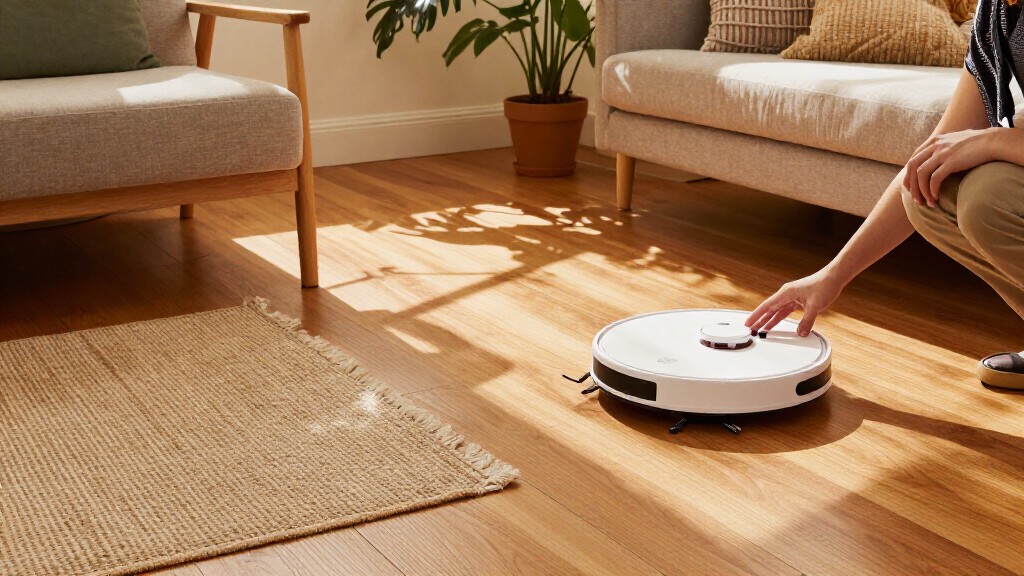
How We Picked
I ranked these models around the needs of a hardwood household: dependable pickup of dust and everyday debris, navigation that can cover rooms without repeated supervision, and a design that is appropriate for hard flooring. I also weighed mop capability carefully. A mop can be useful for light surface cleaning, but it is not a substitute for checking whether a robot’s water control and pad care suit a particular floor finish. Where product names provide a suction figure, I treated it as one data point rather than a direct prediction of real-world performance.
Convenience and ownership demands separated the rankings. Self-emptying docks and more automated mop systems can reduce routine work, but they take up space and add components to maintain. Simpler robots may be a better value for small, uncluttered homes or buyers who prefer manual bin emptying. I placed versatile, well-equipped models higher for shoppers seeking one main robot, while reserving lower positions for options with narrower use cases or fewer convenience features—not because a basic robot cannot clean hardwood, but because it asks more of its owner.
Factors to Consider When Choosing Robot Vacuum Cleaners For Hardwood Floors
Hardwood-friendly shopping is less about chasing the biggest number on a spec sheet and more about matching the robot’s cleaning method to your floors, layout, and tolerance for upkeep. These broader checks can help prevent a feature-rich purchase from becoming a poor fit.
Choose a mop based on your floor finish, not the feature list
A mop attachment can pick up light residue that vacuuming leaves behind, but moisture tolerance varies by flooring material and finish. Check the flooring maker’s care instructions before using any robot with a water tank, and confirm whether the robot offers adjustable water flow or a way to avoid mopping in selected rooms. A damp pad is different from a wet mop, yet a robot can revisit the same area if its route overlaps. If your floors are sensitive, vacuum-only cleaning may be the more comfortable choice. Do not assume a combo model has to mop every run; some households can use the vacuum function most of the time and reserve mopping for suitable areas.
Treat suction figures as a clue, not a ranking system
Advertised suction measurements can help distinguish models on paper, but they do not describe every part of pickup performance. Brush contact, airflow, debris size, and whether the robot can maintain suction as its bin fills all shape what gets collected. Hardwood usually does not demand the same carpet-focused approach as a home with thick pile, so a very high figure may matter less than reliable coverage and a brush that handles hair without constant clearing. Compare the whole cleaning system rather than buying by the largest number. If your main problem is fine dust or crumbs on hard floors, navigation and repeatable passes may matter more than extra suction capacity.
Match navigation to the shape of your home
Room layout can change the value of navigation features more than floor area alone. Open plans are relatively forgiving, while narrow hallways, clusters of chair legs, and rooms with frequent obstacles can expose a robot that wanders or misses sections. Think about whether you need room-by-room scheduling, no-go zones, or a map that can be edited after furniture moves. A basic navigation system may be adequate in a small, uncluttered space, but it can demand more pickup and rescue work in a complex home. Before buying, check how the robot handles thresholds and whether its mapping tools match the way you actually use each room.
Decide how much automation earns its footprint
A self-emptying dock reduces how often you handle the robot’s dust bin, which can be helpful in a busy home or one with pets. Larger stations need a clear parking area and still require attention, since bags, filters, and dock surfaces do not maintain themselves. Mop-focused stations can add further convenience, but they also bring more parts to clean and more space demands. For a small apartment or a household that runs the robot occasionally, a compact charger and manual emptying may be easier to live with. Measure the intended dock location before choosing a model, including room to approach and remove consumables.
Plan for hair, edges, and routine maintenance
Long hair and pet fur can wrap around brush rolls even when a robot performs well on hardwood. Check whether the brush and filter are easy to remove, and factor in the time needed to clear tangled hair from wheels and axles. Edge cleaning matters too: dust tends to collect along baseboards and under furniture, where a robot’s shape and side brush affect coverage. A device that is easy to clean after each run can be a better long-term fit than one with more features but fiddly access. Keep replacement parts and filter availability in mind, since maintenance friction often determines whether a robot stays in regular use.
Spend extra for a problem you actually have
Premium automation makes the clearest difference when you run the robot often, cover several rooms, or want less hands-on bin and mop care. It is harder to justify if your home is small, the floor plan is simple, or you prefer to control each cleaning session yourself. A combo robot can also be wasted capability if you will not use its mop or cannot use moisture on your flooring. Start with the job that causes the most friction—frequent emptying, missed rooms, pet hair, or occasional mopping—and pay for features that address it. This approach helps avoid buying a dock or app ecosystem that adds complexity without changing your routine.
Frequently Asked Questions
Can I use a robot vacuum mop on every hardwood floor?
No. Hardwood finishes and manufacturer care rules differ, so I would check the flooring guidance before letting a robot dispense water. If the floor is not suited to damp cleaning, choose a vacuum-only model or disable the mop function. For compatible floors, use the lowest suitable water setting and avoid leaving a wet pad attached between runs. A robot’s mop feature is for light upkeep, not soaking or scrubbing. When uncertain, test the cleaning method in a discreet area and watch for any change in the finish.
Is a higher Pa suction rating worth prioritizing for hardwood?
Not on its own. A higher stated Pa figure may appeal if you also clean rugs or collect heavier debris, but it does not tell you how well the brush picks up dust or how consistently the robot covers a room. For hardwood-only homes, I would compare navigation, brush maintenance, and edge coverage alongside suction. The Qrevo 2 Pro’s stated 20,000 Pa is a clear spec distinction in this lineup, but buyers should not treat that number as proof of better performance on every floor. Choose the overall cleaning system that fits your debris and layout.
Should I pay extra for a self-emptying dock if I have hardwood floors?
Floor type alone does not make a self-emptying dock necessary; cleaning frequency and household debris are better guides. If the robot runs often or collects plenty of hair and dust, fewer manual bin trips can make ownership easier. A dock also takes up space and introduces consumables and surfaces that need care, so it may be more apparatus than a small home needs. Models such as the Shark AV2501AE and Roborock Q10 S5+ show how self-emptying can be a central convenience feature in this lineup. If you rarely run a robot, a simpler bin may be a sensible tradeoff.
Is a vacuum-only robot a better choice than a vacuum-and-mop combo?
It can be, especially if your flooring care rules discourage moisture or you prefer to mop by hand. A vacuum-only model also avoids water-tank and pad maintenance, which keeps the routine simpler. A combo makes more sense when the floor can be damp-cleaned and you will use that feature regularly. Do not pay for a mop attachment just because it is included; unused features can add upkeep without improving your cleaning routine. Decide based on the floor’s care requirements and how you handle spills and stuck-on marks.
What should I check before buying a robot for a home with rugs and hardwood?
Check how the robot handles floor transitions, whether it can recognize rugs, and whether its mop function can avoid carpeted areas. A combo robot that wets a rug can create more work than it saves if it lacks useful room settings or rug avoidance. Also consider whether the robot’s brush and suction suit the rugs’ pile, since a model designed mainly for hard floors may not satisfy a mixed-floor home. Look for mapping controls that let you separate cleaning zones and set no-mop areas. If rugs cover a large share of your rooms, prioritize mixed-floor performance over hardwood convenience alone.
Conclusion
For one robot to cover regular hardwood care with a mix of vacuuming, mopping, and dock convenience, I’d choose the Roborock Qrevo S Pro as best overall. The Roborock Qrevo 2 Pro is my best premium pick for shoppers drawn to its high stated suction and combo format, while the Tikom L8000 Plus is a best value candidate for buyers seeking a self-emptying vacuum-and-mop setup without moving straight to a higher-end Roborock. For a straightforward, vacuum-only routine, the iRobot Roomba 105 is my beginner-friendly choice; the Shark AV2501AE makes more sense for buyers who specifically want a HEPA self-empty base and do not need mopping. If you want a compact, basic robot and are comfortable with fewer automated conveniences, look to the ILIFE V2 or Lefant M210. Choose according to your floor-care rules and willingness to maintain the dock, not a suction figure alone.