Finding the right astronomy telescope involves balancing performance, ease of use, and price. The Celestron NexStar 8SE stands out as the best overall choice for its advanced features and reliable optics, while the Gskyer 70mm Aperture Refracting Telescope offers an excellent entry point for beginners on a budget. Many buyers grapple with whether to prioritize high magnification or portability, and whether to choose computerized models or simple manual scopes. Keep reading for a detailed comparison that highlights what each model does best and who it’s ideal for.

Get furniture and decor delivered free with Prime
- Fast, free delivery on millions of items
- Prime Video, Amazon Music and more included
- Member-only deals all year
Complete the kit


Key Takeaways
- Top-ranking models like the Celestron NexStar 8SE combine high performance with user-friendly features, making them ideal for serious amateurs.
- Budget options such as the Gskyer 70mm excel for beginners and casual stargazing, but they sacrifice some detail and power found in more advanced scopes.
- Smartphone-guided and app-controlled telescopes are increasingly popular, offering easier setup and imaging for tech-savvy users.
- Compact, portable designs like the 80mm travel scopes are perfect for on-the-go astronomy but may have limited aperture for deep-sky viewing.
- A clear distinction exists between scopes designed for casual observation vs. those suitable for astrophotography or more detailed planetary viewing.
| Celticbird 80mm Aperture 600mm AZ Mount Refractor Telescope for Adults and Kids |  | Best for Beginners and Portable Use | Aperture: 80mm | Focal Length: 600mm | Magnification: 30X and 66X with two eyepieces | VIEW ON AMAZON | See Our Full Breakdown |
| MEEZAA 150EQ Newtonian Reflector Telescope for Adults and Beginners |  | Best for Bright, Detailed Deep-Sky and Planetary Viewing | Aperture: 150mm | Focal Length: 650mm | Eyepieces: 25mm & 10mm | VIEW ON AMAZON | See Our Full Breakdown |
| 90mm Telescope for Adults High Powered, Magnification 180X |  | Best for High-Magnification Lunar and Planetary Observation | Aperture: 90mm | Focal Length: 600mm | Magnification Range: 24X–180X | VIEW ON AMAZON | See Our Full Breakdown |
| Celestron NexStar 8SE Computerized Telescope – Schmidt-Cassegrain |  | Best for Advanced Observers and Deep-Sky Exploration | Aperture: 8 inches | Optics: Schmidt-Cassegrain | Mount: Computerized GoTo | VIEW ON AMAZON | See Our Full Breakdown |
| Celestron StarSense Explorer DX 130AZ Smartphone Guided Newtonian Telescope |  | Best for Guided Sky Tours and Ease of Use | Aperture: 130mm | Type: Newtonian reflector | Mount: Manual altazimuth | VIEW ON AMAZON | See Our Full Breakdown |
| MEEZAA 90mm Aperture Refractor Telescope for Adults |  | Best for Beginners Seeking Versatile Observation | Aperture: 90mm | Focal Length: 800mm | Magnification: 32X-240X | VIEW ON AMAZON | See Our Full Breakdown |
| Celestron StarSense Explorer LT 114AZ Smartphone Guided Telescope |  | Best for Tech-Savvy Beginners with Smartphone Integration | Aperture: 114mm | Type: Newtonian reflector | Mount: Manual altazimuth | VIEW ON AMAZON | See Our Full Breakdown |
| Celestron AstroMaster 130EQ Telescope for Beginners |  | Best for Beginners Wanting a Stable, Versatile Setup | Optical Diameter: 130mm | Type: Newtonian reflector | Mount: German equatorial | VIEW ON AMAZON | See Our Full Breakdown |
| Gskyer 70mm Aperture 400mm AZ Mount Astronomical Refracting Telescope for Kids and Beginners | 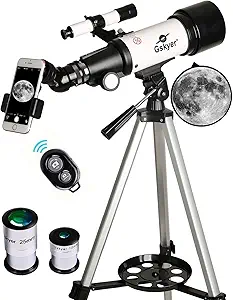 | Best for Kids and Entry-Level Observation | Aperture: 70mm | Focal Length: 400mm | Magnification: Variable | VIEW ON AMAZON | See Our Full Breakdown |
| Telescope for Kids and Adults, 70mm Aperture Refracting Telescope with 15X-150X Magnification |  | Best for All-Ages Outdoor Exploration | Aperture: 70mm | Focal Length: 300mm | Magnification: 15X-150X | VIEW ON AMAZON | See Our Full Breakdown |
| Gskyer 600x90mm AZ Refractor Telescope for Adults |  | Best Overall for Versatile Beginners | Focal Length: 600mm | Aperture: 90mm | Eyepieces: 24X, 60X, 120X | VIEW ON AMAZON | See Our Full Breakdown |
| DWARFLAB Dwarf 3 Smart Telescope, App-Controlled Astrophotography Camera |  | Best for Portable Astrophotography and Outdoor Adventures | Weight: 3 lb / 1.35 kg | Imaging System: Dual lens (telephoto and wide-angle) | Auto-Tracking: Yes | VIEW ON AMAZON | See Our Full Breakdown |
| 80mm Aperture Refractor Telescope for Adults & Beginners, Portable Travel Telescopio with Backpack |  | Best for Family and Travel Astronomy | Aperture: 80mm | Focal Length: 600mm | Eyepieces: K20mm, K9mm | VIEW ON AMAZON | See Our Full Breakdown |
| Koolpte 80mm Aperture Telescope for Adults & Beginners with AZ Mount Tripod, Phone Adapter, Carrying Bag, Wireless Control | 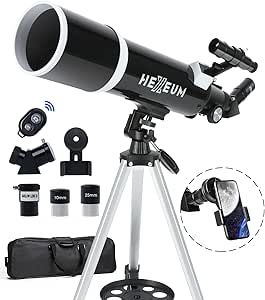 | Best for Advanced Beginners and Portability with Tech Features | Aperture: 80mm | Focal Length: 600mm | Magnification: 24x to 180x | VIEW ON AMAZON | See Our Full Breakdown |
| astronomy telescope | Aperture | Focal Length | Eyepieces | Magnification |
|---|---|---|---|---|
| Celticbird 80mm Aperture 600mm | 80mm | 600mm | — | 30X and 66X with two eyepieces |
| MEEZAA 150EQ Newtonian Reflect | 150mm | 650mm | 25mm & 10mm | — |
| 90mm Telescope for Adults High | 90mm | 600mm | 10mm & 25mm | — |
| Celestron NexStar 8SE Computer | 8 inches | — | — | — |
| Celestron StarSense Explorer D | 130mm | — | — | — |
| MEEZAA 90mm Aperture Refractor | 90mm | 800mm | 10mm and 25mm | 32X-240X |
| Celestron StarSense Explorer L | 114mm | — | 10mm and 25mm | — |
| Celestron AstroMaster 130EQ Te | — | — | 20mm, 10mm | 33x, 65x |
| Gskyer 70mm Aperture 400mm AZ | 70mm | 400mm | — | Variable |
| Telescope for Kids and Adults | 70mm | 300mm | 6mm & 20mm | 15X-150X |
| Gskyer 600x90mm AZ Refractor T | 90mm | 600mm | 24X, 60X, 120X | — |
| DWARFLAB Dwarf 3 Smart Telesco | — | — | — | — |
| 80mm Aperture Refractor Telesc | 80mm | 600mm | K20mm, K9mm | 30x-66x |
| Koolpte 80mm Aperture Telescop | 80mm | 600mm | 25mm and 10mm | 24x to 180x |
More Details on Our Top Picks
Celticbird 80mm Aperture 600mm AZ Mount Refractor Telescope for Adults and Kids
This lightweight refractor stands out for its portability and user-friendly features, making it ideal for newcomers and families wanting to explore the night sky without heavy equipment. Compared with the Celestron StarSense Explorer DX 130AZ, it offers easier setup and a more compact design, though it sacrifices some magnification power and optical sharpness. The 80mm aperture provides bright images of the Moon and planets, but its limited magnification of 66X can fall short for more serious astronomy. The included backpack, phone adapter, and moon filter enhance accessibility, especially for casual observers. However, manual setup might challenge absolute beginners, and the optical quality isn’t on par with higher-end scopes. This pick makes the most sense for families or casual sky watchers who prioritize portability and ease of use over advanced features.
Pros:- Lightweight and portable with included backpack
- Adjustable tripod suits both adults and children
- Easy to assemble with clear instructions
- Bright, clear images suitable for lunar and planetary observation
Cons:- Limited to 66X magnification, not ideal for deep-sky or planetary details
- Manual setup can be challenging for complete novices
- Optical quality is basic compared to higher-end telescopes
Best for: Beginners, families, and casual sky watchers seeking portability and simplicity
Not ideal for: Advanced astronomers or users seeking high magnification and detailed planetary views
- Aperture:80mm
- Focal Length:600mm
- Magnification:30X and 66X with two eyepieces
- Finderscope:5×24
- Tripod Height Range:17.7″ to 52″
- Included Accessories:Backpack, phone adapter, moon filter
Our verdict“This telescope is perfect for beginners and families prioritizing portability and ease of use over high magnification.”
MEEZAA 150EQ Newtonian Reflector Telescope for Adults and Beginners
This 150mm aperture reflector offers impressive brightness and detail, making it a clear choice over smaller scopes like the Celticbird 80mm when it comes to viewing planets and deep-sky objects. Its large aperture captures more light, revealing finer details on the Moon, planets, and brighter galaxies. The German equatorial mount ensures smooth tracking, a significant advantage over simple altazimuth mounts, especially for astrophotography. However, assembly can be time-consuming, and the sturdy tripod adds weight, reducing portability. It’s best suited for users willing to invest time in setup who want more detailed views than a beginner refractor can provide. This telescope strikes a balance between beginner-friendly features and a performance level suitable for those ready to upgrade from smaller scopes.
Pros:- Large 150mm aperture delivers bright, detailed images
- Stable German equatorial mount allows precise tracking
- Includes comprehensive accessories for versatile viewing
- Good for planetary, lunar, and some deep-sky objects
Cons:- Assembly can be complex and time-consuming
- Heavier and less portable due to sturdy tripod
- Initial setup may be intimidating for absolute beginners
Best for: Beginner and intermediate users eager to explore deep-sky objects and planetary details
Not ideal for: Travelers or casual observers who need a lightweight, portable option
- Aperture:150mm
- Focal Length:650mm
- Eyepieces:25mm & 10mm
- Magnification Range:26X to 130X
- Mount:German Equatorial
- Accessories:Phone adapter, moon filter, carry bag, finderscope, Barlow lens
Our verdict“This reflector is well-suited for those seeking brighter, more detailed views and willing to handle a larger, more involved setup process.”
90mm Telescope for Adults High Powered, Magnification 180X
This 90mm scope excels at delivering high magnification, making it ideal for detailed lunar and planetary views, unlike the more general-purpose Celticbird 80mm. Its fully coated optics and versatile eyepieces enable sharp, high-contrast images up to 180X, appealing to enthusiasts who want to see craters, lunar details, and planetary bands with clarity. The portable tripod and phone adapter add convenience for on-the-go viewing and basic astrophotography. Still, the manual focus system can require fine-tuning, and stability may suffer on uneven surfaces, limiting its suitability for astrophotography or extended viewing sessions. This telescope is perfect for those primarily interested in lunar and planetary detail rather than deep-sky objects.
Pros:- High magnification up to 180X for detailed lunar and planetary views
- Fully multi-coated optics ensure bright, sharp images
- Portable with adjustable tripod and phone adapter
- Affordable option for high-magnification viewing
Cons:- Manual focus can be tricky to fine-tune
- Limited use for deep-sky objects due to size and design
- Tripod stability varies depending on surface
Best for: Lunar and planetary enthusiasts who value high magnification and portability
Not ideal for: Deep-sky observers or those seeking long-exposure astrophotography capabilities
- Aperture:90mm
- Focal Length:600mm
- Magnification Range:24X–180X
- Eyepieces:10mm & 25mm
- Barlow Lens:3×
- Mount:Altazimuth
Our verdict“This scope is best for lunar and planetary observers wanting high magnification in a portable format, not for deep-sky exploration.”
Celestron NexStar 8SE Computerized Telescope – Schmidt-Cassegrain
The Celestron NexStar 8SE stands out for its powerful 8-inch aperture that captures stunning lunar, planetary, and deep-sky images, surpassing smaller scopes like the MEEZAA 150EQ in detail and brightness. Its fully automated GoTo system with SkyAlign makes setup straightforward, even for those new to computerized telescopes, though it does require initial alignment. The Schmidt-Cassegrain design packs a large aperture into a relatively compact and portable package, making it suitable for serious hobbyists who want professional-level views without a bulky setup. The main tradeoff is the higher price and the need for some familiarity with computerized operation. This telescope makes sense for users who prioritize high-quality images and automated features over simplicity.
Pros:- Large 8-inch aperture yields sharp, detailed images
- Automated GoTo with SkyAlign simplifies locating objects
- Compact design for its size and power
- Extensive object database for diverse observing
Cons:- Requires initial alignment, which can be complex for newcomers
- Higher cost compared to entry-level scopes
- Setup may be intimidating for absolute beginners
Best for: Intermediate to advanced amateur astronomers seeking detailed deep-sky and planetary views with automation
Not ideal for: Complete beginners who prefer manual operation or low-budget setups
- Aperture:8 inches
- Optics:Schmidt-Cassegrain
- Mount:Computerized GoTo
- Object Database:40,000+ objects
- Warranty:2 years
Our verdict“This scope is a strong choice for those seeking high-quality images and automated operation, willing to handle a more complex setup process.”
Celestron StarSense Explorer DX 130AZ Smartphone Guided Newtonian Telescope
The StarSense Explorer DX 130AZ combines a 130mm aperture with innovative smartphone-guided sky recognition technology, making it particularly appealing to beginners and casual observers who want quick access to celestial objects. Its manual altazimuth mount with smooth tracking is straightforward to operate, similar to the Gskyer 70mm AZ, but with a larger aperture for brighter views. Unlike the Celticbird 80mm, this model offers a more modern, tech-assisted experience that helps users find objects easily. The main limitation is reliance on a smartphone, which can be restrictive if the device is unavailable or incompatible. Overall, this telescope suits those who want guided discovery with minimal fuss, especially if they already own a compatible phone.
Pros:- Smartphone-guided sky recognition simplifies object locating
- Bright 130mm aperture for detailed views
- Smooth manual mount for easy tracking
- Includes a 2-year US warranty and support
Cons:- Relies heavily on a smartphone for optimal use
- Manual mount may be less stable for astrophotography
- Less suitable for users without compatible devices
Best for: Beginner and intermediate sky watchers interested in guided star tours and smartphone control
Not ideal for: Experienced astronomers or those without smartphones seeking manual, high-precision control
- Aperture:130mm
- Type:Newtonian reflector
- Mount:Manual altazimuth
- Technology:StarSense Explorer
- Warranty:2-year US warranty
Our verdict“This telescope is ideal for beginners wanting guided sky tours and smartphone integration, not for those preferring manual or high-precision control.”
MEEZAA 90mm Aperture Refractor Telescope for Adults
The MEEZAA 90mm Aperture Refractor stands out as a solid choice for newcomers wanting a straightforward setup with decent light-gathering ability. Its 90mm aperture captures more light than smaller beginner models like the Gskyer 70mm, resulting in clearer lunar and planetary images. The included multiple eyepieces and Barlow lens offer flexible magnification options, making it easier to explore different celestial features. Compared with the Celestron AstroMaster 130EQ, it’s lighter and more portable, though it sacrifices some capability for deep-sky objects due to its limited magnification range. The manual tripod is easy to adjust but may wobble at higher magnifications, especially at maximum height. Overall, this telescope makes the most sense for beginners interested primarily in lunar and planetary viewing, but it’s less suitable for those wanting astrophotography or deep-sky exploration.
Pros:- High-quality 90mm aperture captures more light for clearer images
- Includes multiple eyepieces and a Barlow lens for versatile magnification
- Easy to assemble with a detailed manual and portable carry bag
Cons:- Limited to basic astronomical observations, not suitable for astrophotography
- Magnification range may be insufficient for deep-sky objects
- Tripod stability can be limited at maximum height
Best for: Beginners and casual skywatchers who want an easy-to-use, portable telescope for lunar and planetary observation.
Not ideal for: Advanced astronomers or astrophotographers who need high magnification and long exposure capabilities.
- Aperture:90mm
- Focal Length:800mm
- Magnification:32X-240X
- Eyepieces:10mm and 25mm
- Barlow Lens:3X
- Tripod Height:28 to 46 inches
Our verdict“This pick is ideal for beginners looking for a portable, straightforward telescope focused on lunar and planetary viewing.”
Celestron StarSense Explorer LT 114AZ Smartphone Guided Telescope
The Celestron StarSense Explorer LT 114AZ redefines beginner stargazing through its innovative smartphone-guided technology. Unlike the Gskyer 70mm, which relies solely on manual targeting, this model uses your phone’s camera and StarSense app to identify objects in real time. Its 114mm Newtonian reflector delivers bright, detailed views of planets and some deep-sky objects, providing a richer viewing experience than smaller, simpler models. However, it requires a compatible smartphone with the latest OS versions, making it less suitable for those with older devices. The manual altazimuth mount offers basic control but may struggle with stability during prolonged observations, especially compared to the more stable German equatorial mount of the AstroMaster 130EQ. This telescope is perfect for tech-savvy beginners eager to combine astronomy with mobile photography, but less so for those without compatible devices or seeking long-term stability.
Pros:- Smartphone-guided navigation simplifies star and planet identification
- Bright 114mm reflector provides detailed views
- Includes multiple eyepieces and a full-height tripod for versatility
Cons:- Requires a compatible smartphone with the StarSense app for optimal use
- Manual mount may be less stable for extended viewing sessions
- Limited compatibility with older devices
Best for: Beginners who want an intuitive, smartphone-guided experience and are comfortable with technology.
Not ideal for: Users without compatible smartphones or those seeking advanced tracking and astrophotography features.
- Aperture:114mm
- Type:Newtonian reflector
- Mount:Manual altazimuth
- Eyepieces:10mm and 25mm
- Tripod:Full-height
- Warranty:2 years
Our verdict“Great for beginners eager to combine mobile tech with astronomy, provided they have a compatible smartphone.”
Celestron AstroMaster 130EQ Telescope for Beginners
The Celestron AstroMaster 130EQ offers a balanced mix of ease of use and optical performance, making it ideal for beginners who want a stable platform to learn celestial navigation. Its 130mm reflector gathers more light than smaller models like the Gskyer 70mm, revealing lunar craters and planetary details vividly. The German equatorial mount is a step up from simple altazimuth mounts, providing better stability and easier tracking for extended viewing sessions. Compared with the MEEZAA 90mm, it’s heavier but more capable of deep-sky observations thanks to a larger aperture. However, manual tracking requires some practice, and its weight can limit portability. This telescope suits those eager to explore a broad range of celestial objects with a reliable, beginner-friendly setup.
Pros:- Easy and quick setup with minimal assembly
- High-quality optics with good light-gathering power
- Stable, adjustable German equatorial mount for better tracking
Cons:- Manual tracking may require practice for precise object following
- Weight can be cumbersome for portable use
- Limited to beginner to intermediate experience levels
Best for: Beginner to intermediate astronomers seeking a stable, versatile telescope with room to grow.
Not ideal for: Those prioritizing portability or astrophotography, as the mount requires skill to track objects accurately.
- Optical Diameter:130mm
- Type:Newtonian reflector
- Mount:German equatorial
- Eyepieces:20mm, 10mm
- Magnification:33x, 65x
- Included Accessories:StarPointer finderscope, astronomy software
Our verdict“A solid choice for beginners ready to explore more celestial objects with a stable and expandable setup.”
Gskyer 70mm Aperture 400mm AZ Mount Astronomical Refracting Telescope for Kids and Beginners
The Gskyer 70mm is an accessible, lightweight telescope designed for kids and beginners who want a straightforward introduction to astronomy. Its 70mm aperture provides decent lunar and planetary views, but falls short compared to larger models like the MEEZAA 90mm or AstroMaster 130EQ for deep-sky objects. The fully coated optics improve image clarity, and the included accessories—such as a phone adapter and wireless remote—make capturing images easy. While the compact size and adjustable tripod make it highly portable, the smaller aperture limits detailed observation and astrophotography potential. Its simple design means it’s not ideal for serious astronomers but perfect for young explorers and casual stargazing sessions.
Pros:- Suitable for kids and beginners to explore astronomy
- Includes phone adapter and wireless remote for simple photography
- Portable with adjustable tripod and carry bag
Cons:- Limited aperture size for advanced celestial observations
- Magnification depends on eyepieces and Barlow lens, may need extra accessories
- Inverted images in finderscope may require adjustment
Best for: Kids and beginners seeking an easy, portable telescope for lunar and planetary spotting.
Not ideal for: Anyone interested in more detailed astrophotography or deep-sky observation, as the aperture is limited.
- Aperture:70mm
- Focal Length:400mm
- Magnification:Variable
- Finder Scope:5×24 with cross-hair lines
- Tripod:Adjustable aluminum alloy
- Included Accessories:Phone adapter, wireless remote, carry bag
Our verdict“A good starter telescope for young users and casual stargazers looking for portability and ease of use.”
Telescope for Kids and Adults, 70mm Aperture Refracting Telescope with 15X-150X Magnification
This 70mm refracting telescope offers a versatile zoom range from 15X to 150X, making it suitable for both terrestrial and celestial viewing. Its simple assembly and included accessories, such as a phone adapter and wireless remote, make it accessible for kids and adults alike. The 300mm focal length provides decent image quality for lunar and planetary detail, but the inverted images and basic mount mean it’s not designed for astrophotography or precise tracking. Compared with the Gskyer 70mm, this model provides a wider magnification range, though the optical quality is similar. It’s an ideal choice for outdoor family outings and beginner astronomy, but it won’t satisfy users seeking high-performance deep-sky observing or astrophotography.
Pros:- Easy to assemble and suitable for all ages
- Wide magnification range from 15X to 150X
- Includes phone adapter and wireless remote for photos
Cons:- Inverted image in finderscope may need adjustment
- Limited to beginner-level observations, not for advanced astronomy
- Image quality heavily depends on atmospheric conditions
Best for: Families and outdoor enthusiasts interested in casual lunar, planetary, and terrestrial viewing.
Not ideal for: Advanced astronomers or those wanting detailed astrophotography capabilities.
- Aperture:70mm
- Focal Length:300mm
- Magnification:15X-150X
- Eyepieces:6mm & 20mm
- Barlow Lens:3X
- Finderscope:5×24
- Tripod Height:up to 45 inches
Our verdict“A flexible, easy-to-use telescope perfect for outdoor family adventures and beginner exploration.”
Gskyer 600x90mm AZ Refractor Telescope for Adults
The Gskyer 600x90mm AZ Refractor Telescope stands out for its combination of quality optics and user-friendly features, making it a strong choice for those new to astronomy who want to explore both lunar and planetary details. Compared with the 80mm models, its larger 90mm aperture provides brighter images and better light gathering, which is especially noticeable in low-light conditions. While it lacks motorized tracking, the included multiple eyepieces and Barlow lens offer flexible magnification options, and the adjustable tripod ensures comfortable viewing angles. The main tradeoff is that manual focus can be a bit finicky, and without motorized tracking, long observations of moving objects become challenging for more advanced users. Overall, this telescope suits entry-level enthusiasts eager for a solid, expandable platform, but less ideal for those seeking high-end astrophotography or automated tracking systems.
Pros:- High-quality fully coated optics for crisp, bright images
- Includes multiple eyepieces and a Barlow lens for versatile magnification
- Adjustable tripod for comfortable viewing positions
- Suitable for lunar, planetary, and terrestrial observations
Cons:- Manual focusing may require some adjustment for sharp images
- Lacks motorized tracking, limiting long-exposure or high-precision viewing
Best for: Beginners who want a reliable, versatile telescope that can handle lunar, planetary, and terrestrial views.
Not ideal for: Experienced astrophotographers or users needing motorized tracking for lengthy, precise observations.
- Focal Length:600mm
- Aperture:90mm
- Eyepieces:24X, 60X, 120X
- Barlow Lens:3x
- Tripod Height Range:31.5 to 49 inches
- Finderscope:6×30
Our verdict“This telescope is a well-rounded option for beginners seeking an adaptable, easy-to-use platform with room to grow.”
DWARFLAB Dwarf 3 Smart Telescope, App-Controlled Astrophotography Camera
The DWARFLAB Dwarf 3 excels in portability and smart features, making it ideal for outdoor enthusiasts and budding astrophotographers who value convenience. Its lightweight design at just 3 pounds allows for easy transport, and the dual imaging systems (telephoto and wide-angle) provide versatility for daytime and nighttime photography alike. Unlike bulkier telescopes such as the Celestron NexStar 8SE, the Dwarf 3’s auto-tracking and cloud-powered image processing enable quick, high-quality captures without complex setup, but it does rely heavily on a smartphone app for full functionality. Its 4K resolution and user-friendly interface make it suitable for all skill levels, though beginners may face a learning curve in mastering astrophotography techniques. Compared to traditional telescopes, this option prioritizes convenience and mobility over deep-sky capabilities.
Pros:- Ultra-lightweight and portable for travel
- Dual imaging systems for versatile shooting
- Smart auto-tracking and cloud-based image processing
- 4K resolution for high-quality photos
Cons:- Requires smartphone app, adding complexity
- Limited detailed specifications in the description
- Potential learning curve for new astrophotographers
Best for: Travelers and outdoor lovers seeking a lightweight, high-tech astrophotography tool that is easy to carry and operate.
Not ideal for: Users aiming for deep-sky astrophotography or those requiring detailed manual control without app dependence.
- Weight:3 lb / 1.35 kg
- Imaging System:Dual lens (telephoto and wide-angle)
- Auto-Tracking:Yes
- Resolution:4K
- Connectivity:USB-C
- App Compatibility:Yes
Our verdict“This smart, portable telescope is perfect for outdoor adventurers who want quick, high-quality astrophotography without complex equipment.”
80mm Aperture Refractor Telescope for Adults & Beginners, Portable Travel Telescopio with Backpack
This 80mm aperture refractor offers a straightforward, portable solution for families, outdoor explorers, and beginners eager to observe the moon, planets, and landscapes. Its large 80mm lens gathers enough light to produce bright, detailed images, making it more capable than smaller kid-oriented telescopes. The included backpack, adjustable tripod, and accessories like a phone adapter make it a travel-friendly choice, but its limited magnification (30x-66x) may fall short for more advanced planetary or deep-sky viewing. Assembly is simple, yet some users might find the basic tripod insufficient for high-magnification or precise observations. This pick balances ease of use and portability, though it doesn’t match the deep-sky performance of larger or motorized models like the Celestron NexStar 8SE.
Pros:- Bright, clear images with a large 80mm aperture
- Portable with a carrying backpack included
- Easy assembly and comprehensive accessories
- Adjustable tripod for comfortable viewing
Cons:- Limited magnification range for advanced astronomy
- Basic tripod may lack stability at higher magnifications
- Requires some setup knowledge
Best for: Families, kids, and beginners wanting a portable, easy-to-use telescope for casual astronomy outings.
Not ideal for: Intermediate or advanced users seeking high magnification or deep-sky observation capabilities.
- Aperture:80mm
- Focal Length:600mm
- Eyepieces:K20mm, K9mm
- Magnification:30x-66x
- Finder Scope:5×24 with crosshair
- Accessories:Phone adapter, tripod, backpack
Our verdict“This travel-ready telescope makes a great introduction for families and beginners looking for a simple, portable viewing experience.”
Koolpte 80mm Aperture Telescope for Adults & Beginners with AZ Mount Tripod, Phone Adapter, Carrying Bag, Wireless Control
The Koolpte 80mm Aperture Telescope combines high-quality optics with modern features, making it suitable for beginners who want more magnification and remote control capabilities. Its fully multi-coated lenses produce bright images, and the adjustable AZ mount allows for smooth tracking up to 180x magnification with included eyepieces and a Barlow lens. Unlike simpler models like the 80mm refractor, the wireless remote and phone adapter enable effortless image capturing, while the portable tripod and carrying bag support outdoor use. However, the higher maximum magnification may be limited by the stability of the lightweight tripod, and the absence of advanced software features might disappoint more serious astrophotographers. This telescope is a good bridge for those wanting a balance of ease, tech, and upgrade potential, though it’s not ideal for deep-sky astronomy at the highest magnifications.
Pros:- High-quality fully multi-coated optical lenses
- Portable with a lightweight, adjustable tripod
- Wireless remote and phone adapter for easy image capture
- Magnification up to 180x with included accessories
Cons:- Tripod stability may be insufficient at maximum magnifications
- Limited advanced software or deep-sky features
- Some users may find assembly or setup challenging
Best for: Beginner to intermediate users seeking a portable, feature-rich telescope with remote and smartphone control.
Not ideal for: Users aiming for deep-sky astrophotography or requiring extremely stable mounts for high-magnification detailed views.
- Aperture:80mm
- Focal Length:600mm
- Magnification:24x to 180x
- Eyepieces:25mm and 10mm
- Finder Scope:5×24
- Mount:AZ Mount
Our verdict“This versatile telescope offers tech-savvy beginners a portable, high-magnification platform with remote control features, ideal for casual and semi-serious astronomy.”

How We Picked
The telescopes in this roundup were selected based on a combination of performance, usability, build quality, and value. We prioritized models with proven optical performance, ease of assembly and operation for both beginners and experienced users, and features that enhance the stargazing experience—such as computerized tracking or smartphone connectivity. Price range was also a consideration, ensuring a diverse lineup that fits different budgets. Our ranking reflects how well each telescope balances these factors, with a focus on real-world usability and long-term satisfaction.| astronomy telescope | Mount |
|---|---|
| Celticbird 80mm Aperture 600mm | — |
| MEEZAA 150EQ Newtonian Reflect | German Equatorial |
| 90mm Telescope for Adults High | Altazimuth |
| Celestron NexStar 8SE Computer | Computerized GoTo |
| Celestron StarSense Explorer D | Manual altazimuth |
| MEEZAA 90mm Aperture Refractor | — |
| Celestron StarSense Explorer L | Manual altazimuth |
| Celestron AstroMaster 130EQ Te | German equatorial |
| Gskyer 70mm Aperture 400mm AZ | — |
| Telescope for Kids and Adults | — |
| Gskyer 600x90mm AZ Refractor T | — |
| DWARFLAB Dwarf 3 Smart Telesco | — |
| 80mm Aperture Refractor Telesc | — |
| Koolpte 80mm Aperture Telescop | AZ Mount |
Factors to Consider When Choosing Astronomy Telescopes
Choosing the right astronomy telescope depends on understanding your specific needs and how you plan to use it. Beyond just optical performance, factors like portability, ease of setup, and future expandability matter. Recognizing common pitfalls, such as overestimating magnification or underestimating the importance of sturdy mounts, can save you from buyer’s remorse. This guide will walk through key considerations to help you find a telescope that offers the best value and experience for your investment.Aperture Size and Magnification
The aperture size determines how much light the telescope can gather, directly affecting image brightness and clarity, especially for deep-sky objects. Larger apertures generally deliver better detail but come with increased size and weight. Magnification is often overemphasized; a higher magnification doesn’t necessarily mean better images if the optics can’t support it. Instead, focus on a balanced aperture with a manageable magnification range suitable for your targets and experience level.
Ease of Use and Setup
For beginners, quick setup and intuitive controls are vital. Computerized or motorized mounts can simplify locating objects but add complexity and cost. Manual scopes with simple tracking are more straightforward but may require more skill and patience. Consider whether you prefer a lightweight, portable design for travel or a more stable, feature-rich mount for detailed observation. Mistakes here often involve choosing scopes that are too complicated or too fragile for your intended use.
Portability and Size
If you plan to carry your telescope to dark-sky sites or travel frequently, compact models with lightweight frames are appealing. However, smaller scopes might limit your viewing capabilities of faint objects. Larger, more stable telescopes often provide better performance but can be cumbersome and require more storage space. Balancing portability with optical performance is essential, especially if you lack a dedicated observatory space.
Accessories and Expandability
Additional accessories like eyepieces, filters, or smartphone adapters can enhance your viewing experience. Some scopes come with built-in features or expandability options that allow for astrophotography or advanced astronomy. Be cautious about buying scopes that lack compatible accessories or are difficult to upgrade—this can limit your growth in the hobby. Consider whether the manufacturer offers a good selection of compatible add-ons to future-proof your investment.
Budget and Long-Term Value
While it might be tempting to choose the cheapest option, investing in a slightly more expensive model often yields better optics, durability, and features that last years. Lower-cost scopes may require upgrades sooner or produce frustrating images, especially for serious hobbyists. Evaluate your budget against your goals—spending more upfront can pay off in better satisfaction and fewer replacements down the line.
Frequently Asked Questions
Is a computerized telescope worth it for a beginner?
Computerized telescopes can significantly streamline the process of locating celestial objects, making them highly appealing for beginners. They reduce the frustration of manual star-hopping and help you learn the night sky faster. However, they tend to be more expensive and require power sources or batteries. If you’re willing to invest and want an easier start, a computerized model can be a worthwhile choice; otherwise, a manual scope offers more hands-on control and can be less costly.
What size aperture should I look for as a beginner?
For newcomers, an aperture between 70mm and 130mm strikes a good balance between portability and viewing quality. Scopes in this range are light enough for easy transport, yet capable of revealing planets, the Moon, and some deep-sky objects. Larger apertures provide better images but come with increased weight and cost, which might be cumbersome for casual or mobile use. Starting with a moderate size allows you to learn the basics without overwhelming complexity or expense.
Can I use a telescope for astrophotography as a beginner?
While some entry-level telescopes are compatible with smartphone adapters and basic cameras, true astrophotography requires stable mounts, precise tracking, and often more advanced features. Many beginner scopes are not optimized for long-exposure imaging, which is essential for capturing faint objects. If astrophotography is a priority, look for models with motorized mounts or dedicated imaging accessories, even if it means a higher initial investment. Starting simple with visual observation can help you decide if you want to pursue imaging further.
What should I consider when choosing a mount?
The mount is crucial for stability and tracking. Altazimuth mounts are straightforward and easy to use, suitable for beginners focusing on visual observation. Equatorial mounts, although more complex, allow for precise tracking of celestial objects, essential for astrophotography and detailed planetary viewing. Ensure the mount can support the weight of your telescope and accessories. Avoid overly flimsy mounts, as they can introduce vibrations that degrade image quality, frustrating your observing sessions.
Are more expensive telescopes always better?
Not necessarily. A higher price often reflects better optics, build quality, and features, but it doesn’t guarantee it’s the right fit for your needs. For casual stargazing or beginners, a mid-range or budget model may be sufficient and more manageable. More expensive telescopes are better suited for advanced users who need high precision, larger apertures, or astrophotography capabilities. Focus on matching the scope’s features with your goals and experience level before considering the price tag.
Conclusion
For casual stargazers or those just starting out, the Gskyer 70mm Refracting Telescope offers affordability and simplicity. Serious amateurs aiming for detailed planetary or deep-sky viewing should consider the Celestron NexStar 8SE for its combination of power and automation. Beginners who want a smooth introduction without complexity might prefer the Celestron AstroMaster 130EQ, while seasoned hobbyists looking to explore astrophotography can opt for the DWARFLAB Dwarf 3 Smart Telescope. Ultimately, your choice depends on your experience, budget, and long-term goals—matching the right model to your specific needs will make your astronomy journey more rewarding.