
Context-aware voice control is revolutionizing virtual assistants by allowing them to understand you better based on your environment, habits, and current activity. They can respond more naturally, adjust volume in noisy settings, and anticipate your needs, making interactions smoother and more personalized. Privacy concerns remain, but developers focus on safeguarding your data while enhancing user experience. As this technology evolves, it promises smarter, more intuitive assistants—exploring these advancements can offer you a glimpse into the future.

Get furniture and decor delivered free — and shop member deals
- Fast, free delivery on millions of items
- Access to Prime Big Deal Days deals on October 6–7
- Prime Video, Amazon Music and more included
Key Takeaways
- Context-aware voice control enables virtual assistants to interpret commands based on environment, habits, and user activity for more natural interactions.
- It enhances personalization by adapting responses and anticipating user needs through continuous learning and contextual cues.
- Privacy concerns arise from extensive data collection, requiring strong security measures and transparent user controls.
- Balancing personalization with privacy involves encryption, clear policies, and giving users control over their data.
- Future applications include smarter device management, health integration, and more intuitive, human-like virtual assistant experiences.
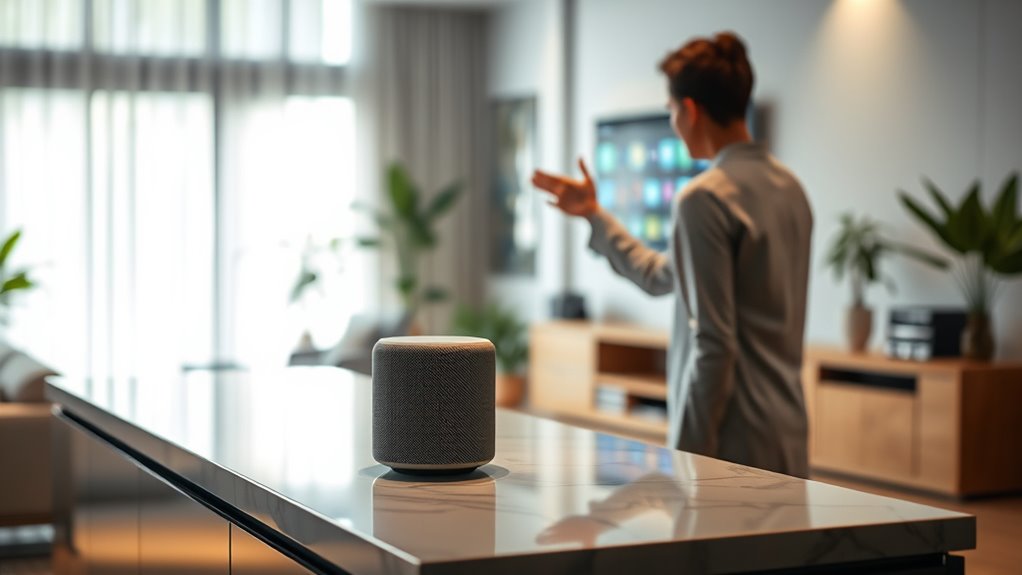
Imagine a voice control system that understands not just your commands, but the context in which you give them. This is the promise of context-aware voice control — a technology that tailors responses based on your environment, habits, and current situation. Instead of rigidly executing commands, it interprets the subtle cues around you, making interactions smoother and more natural. For example, if you’re in a quiet room, the system might respond quietly, while in a noisy environment, it adjusts its volume or offers more visual feedback. This level of user personalization enhances your experience, making virtual assistants feel more intuitive and less like generic tools.
A voice control system that adapts to your environment, making interactions more natural and personalized.
However, as you enjoy the benefits of this smarter technology, privacy concerns inevitably come to the forefront. Context-aware systems gather a wealth of data — from your location and activity to your speech patterns and even your routines. While this data enables highly personalized interactions, it also raises questions about how securely your information is stored and who has access to it. You might worry about accidental data leaks or unauthorized third-party use, especially if the system is constantly listening or recording. Developers need to strike a delicate balance: providing seamless, personalized experiences without compromising your privacy. Implementing robust encryption, transparent data policies, and giving you control over what information is shared are vital steps in building trust.
Despite these concerns, the potential for user personalization in context-aware voice control is significant. Imagine a system that recognizes your voice, adapts to your preferences, and anticipates your needs. It could suggest playlist changes based on your mood, adjust smart home devices automatically, or remind you of upcoming meetings, all without you having to repeat yourself or manually set preferences. With machine learning, these systems can improve over time, becoming more attuned to your habits and routines, creating a truly customized experience. Additionally, researchers are exploring how AI develops cures for common illnesses, which could further revolutionize healthcare and personalized medicine in the future. This personalization not only saves you time but also makes technology feel more like a natural extension of yourself.
Ultimately, the future of virtual assistants lies in their ability to understand you better within your specific context. While privacy concerns are valid, advancements in security and user control can mitigate these issues. By prioritizing user privacy alongside user personalization, developers can craft systems that are both intelligent and trustworthy. As you interact more seamlessly with your digital environment, the line between humans and machines will blur, leading to smarter, more responsive, and more personalized voice-controlled experiences.
smart home voice control devices
As an affiliate, we earn on qualifying purchases.
As an affiliate, we earn on qualifying purchases.
Frequently Asked Questions
How Does Context-Awareness Improve Virtual Assistant Accuracy?
Context-awareness improves virtual assistant accuracy by enabling personalization enhancement and user intent clarification. When your device understands the situation, location, or previous interactions, it can better interpret your commands. This reduces misunderstandings and makes responses more relevant. You’ll experience smoother, more intuitive interactions because the assistant anticipates your needs and tailors its actions accordingly, making your experience more efficient and satisfying.
What Are the Privacy Implications of Context-Aware Voice Control?
Imagine your voice assistant as a trusted friend, but privacy concerns are like shadows lurking nearby. With context-aware voice control, your data security becomes vital, as it processes sensitive information. You must give clear user consent, understanding how your data is used. Without proper safeguards, your personal info could be exposed. Stay vigilant, ask questions, and make certain that privacy measures protect your trust in this evolving technology.
Can Existing Virtual Assistants Adopt Context-Aware Capabilities Easily?
Yes, existing virtual assistants can adopt context-aware capabilities, but it’s not always easy. You’ll face technical challenges like integrating user personalization data while maintaining privacy. Upgrading involves complex algorithms and more data processing, which can strain resources. However, with advances in AI and machine learning, you can enhance your assistant’s understanding of your context, making interactions more seamless and personalized over time.
How Does Context-Aware Voice Control Handle Ambiguous Commands?
When faced with ambiguous commands, your virtual assistant uses disambiguation strategies and contextual reasoning to clarify your intent. It might ask follow-up questions or interpret your previous interactions to determine meaning. Think of it as a clever detective, piecing together clues from your environment and history. So, instead of guessing wildly, it smartly narrows down options, making your voice commands feel like chatting with a well-informed friend who reads between the lines.
What Industries Will Benefit Most From This Technology?
You’ll see healthcare automation and retail personalization benefit most from this technology. In healthcare, it streamlines patient interactions, improves diagnostics, and automates administrative tasks, making care more efficient. Retailers use it for personalized shopping experiences, targeted recommendations, and real-time assistance. Its ability to understand context allows these industries to deliver more intuitive, responsive services, enhancing customer and patient engagement while reducing operational costs.
Conclusion
By embracing context-aware voice control, you’ll find virtual assistants become smarter and more intuitive. They’ll understand your needs better, adapting seamlessly to your environment and habits. Research shows that these systems can markedly improve user experience, making interactions feel natural and effortless. As technology advances, it’s clear that context-aware control isn’t just a trend but the future. So, trust in this innovation—your virtual assistant will become an even more valuable part of your daily life.
Fall Picks
fall essentials
As an affiliate, we earn on qualifying purchases.