Robot vacuums use different tech to navigate your home. Lidar uses lasers to create detailed maps, great for precision and handling complex spaces. Cameras, especially depth and visual ones, help recognize obstacles but can be affected by lighting. Gyroscopes track movement and direction, keeping the robot on course. Choosing the right tech depends on your home and needs. Keep going to discover more about how each works and which might suit you best.
Key Takeaways
- Lidar uses laser beams to create detailed, accurate 3D maps of your home for precise navigation.
- Cameras capture real-time images and help recognize obstacles, but lighting and transparency issues can affect performance.
- Gyroscopes track the vacuum’s orientation and movement, improving navigation accuracy without mapping the environment.
- Lidar provides high-resolution, reliable maps in complex or cluttered spaces, while cameras excel in visual recognition.
- Combining sensors (sensor fusion) offers the best navigation by offsetting individual limitations for thorough cleaning.
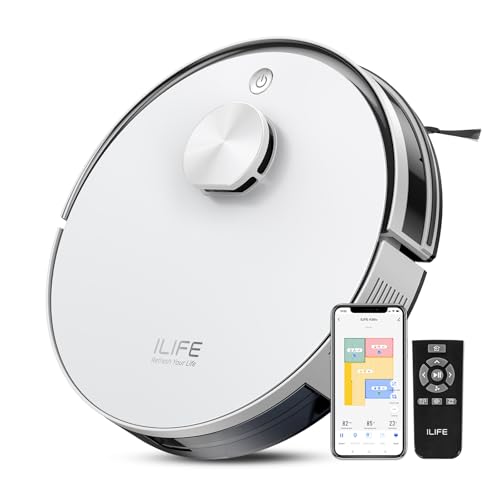
ILIFE A30s Robot Vacuum, 10000Pa Max Suction
- Powerful Suction: Up to 10,000Pa for deep cleaning
- Smart Navigation: LiDAR and SLAM for efficient mapping
- Pet Hair Cleaning: Dual anti-tangle brush for pet households
As an affiliate, we earn on qualifying purchases.
As an affiliate, we earn on qualifying purchases.
How Do Robot Vacuums Map Your Home : The Basics
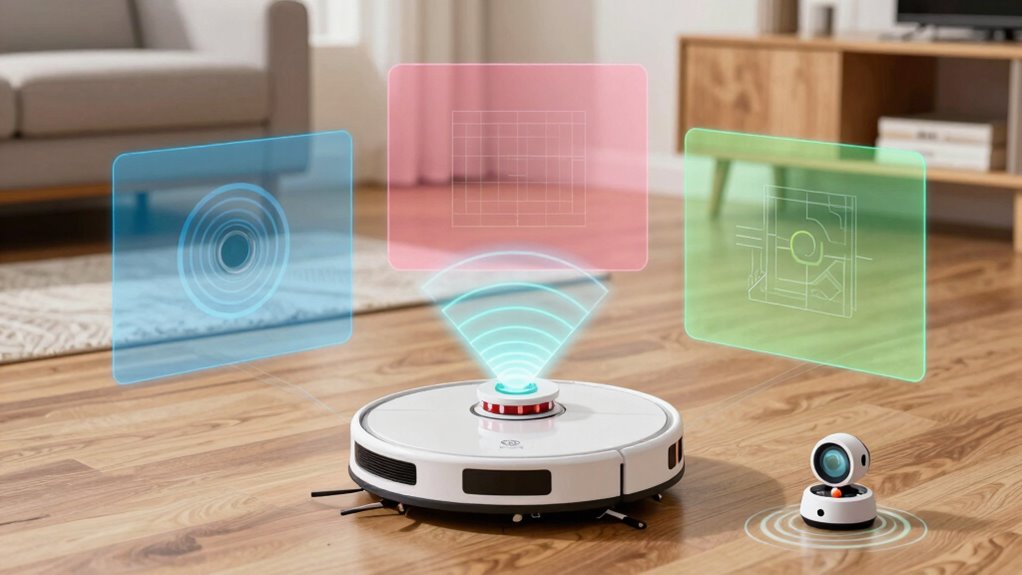
Have you ever wondered how robot vacuums navigate your home so efficiently? They start by analyzing your home layout, creating a mental map as they move. These devices use sensors to detect walls, furniture, and other obstacles, helping them avoid collisions. Obstacle detection is key because it allows the vacuum to adjust its path in real-time, ensuring thorough cleaning without getting stuck. Most robot vacuums follow a systematic route, covering every area methodically. They build an internal map by noting where obstacles are located, which helps them plan efficient cleaning paths. This combination of understanding your home’s layout and detecting obstacles makes cleaning more effective and prevents the robot from missing spots or bumping into things. Additionally, some models utilize advanced sensing technologies like lidar, cameras, or gyroscopes to improve their mapping accuracy and navigation capabilities.
What Is Lidar and Why Do Some Robots Use It?
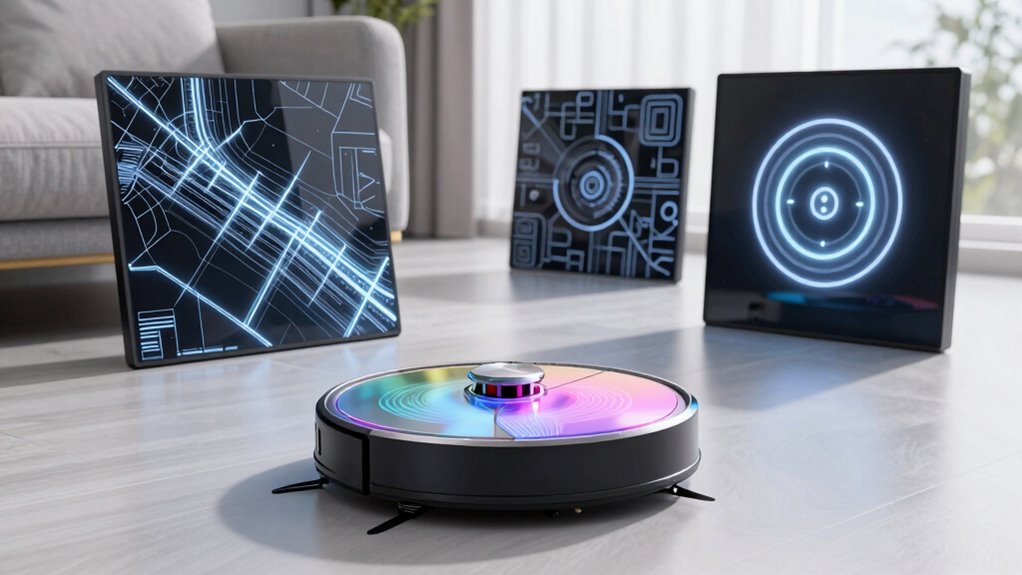
Lidar is a technology that uses laser beams to create detailed maps of your surroundings. It helps robots understand their environment quickly and accurately. The benefits include improved navigation and better cleaning coverage. Additionally, lidar’s ability to generate precise environmental maps enhances a robot’s overall efficiency in complex spaces. Its high resolution and accuracy make it especially useful for mapping complex environments, ensuring thorough and effective cleaning paths. This technology can also adapt to dynamic settings, allowing robots to function effectively in changing conditions. Moreover, advances in lidar have led to more cost-effective solutions, broadening its application in various robotic systems. The integration of lidar with other sensors can further improve robot perception and obstacle avoidance, making robotic cleaning even more reliable.
How Lidar Works
To understand how robots navigate and map their environment, understanding how Lidar works is vital. Lidar emits laser beams that bounce off objects and return to sensors, creating precise distance measurements. This data forms a detailed 3D map instantly, making navigation algorithms more effective. Unlike camera-based systems, Lidar isn’t affected by light changes, ensuring consistent performance. Its accuracy influences robot vacuum design by enabling better obstacle detection and route planning. Here’s a quick comparison:
| Feature | Lidar | Other Sensors |
|---|---|---|
| Accuracy | Very high | Moderate to low |
| Light Dependence | No | Yes |
| Data Type | 3D point cloud | 2D images or signals |
| Speed | Fast | Varies |
| Cost | Typically higher | Usually lower |
This makes Lidar a preferred choice for advanced navigation algorithms.
Benefits of Lidar
Because it provides highly accurate and reliable data, Lidar offers significant advantages for robots maneuvering complex environments. Its robotic sensors quickly create detailed 3D maps, enabling precise navigation. Unlike cameras, Lidar isn’t affected by lighting changes, so it works well day or night. This consistency improves the robot’s navigation algorithms, helping it avoid obstacles and plan efficient routes. Lidar’s ability to measure distances accurately makes it ideal for complex spaces with tight corners or clutter. Many robots prefer Lidar because it provides real-time, high-resolution data that boosts performance. Its ability to detect obstacles further enhances navigation safety and efficiency. Overall, Lidar’s accuracy and reliability help robots clean better, navigate safely, and adapt to different environments with minimal errors. Additionally, Free Floating environments benefit from Lidar’s capacity to map vast, open areas effectively. Incorporating Lidar into navigation systems also enhances topical relevance, ensuring robots operate smoothly across diverse scenarios. Its robustness in various conditions makes Lidar particularly valuable for maintaining consistent performance regardless of environmental changes.
How Do Cameras Help Robot Vacuums See Their Environment?

Cameras on robot vacuums come in different types and offer various capabilities to help navigate your home. They enable the robot to perceive its environment, but they also have limitations that can affect performance. Understanding how these cameras work can help you see their role in creating accurate maps and efficient cleaning paths. Camera technology plays a crucial part in enhancing the robot’s ability to adapt to different layouts and obstacles within your living space. Additionally, sensor integration is essential for combining visual data with other inputs to improve navigation accuracy and obstacle detection. Properly choosing and verifying these sensors ensures reliable operation and longer component life, ultimately delivering better cleaning results. Incorporating emerging AI trends can further optimize how these visual systems interpret and respond to complex environments. Furthermore, advancements in visual processing algorithms are making these systems more capable of handling dynamic and cluttered environments effectively.
Camera Types and Capabilities
Different types of cameras equip robot vacuums with the ability to perceive their surroundings more accurately. These cameras vary in technology and function, enhancing navigation and obstacle detection. For example, you might encounter:
- Depth sensors, which measure distance to objects and create 3D maps of your home.
- Infrared cameras, allowing vacuums to see in low light and detect heat signatures.
- Standard visual cameras, capturing real-time images to identify obstacles and clean areas effectively.
Each type plays a crucial role in environmental awareness, helping your robot navigate efficiently. Depth sensors give precise spatial data, while infrared cameras enable night-time operation. Together, they improve the vacuum’s ability to map and adapt to your home environment.
Environmental Perception and Limitations
While cameras substantially enhance a robot vacuum’s ability to perceive its environment, they also face certain limitations. Cameras rely on visual data, which can be affected by poor lighting, reflections, or shadows, making obstacle detection less reliable in some conditions. To overcome this, many vacuums use sensor fusion—combining camera input with other sensors like lidar or infrared—to improve accuracy. This integration helps the vacuum better recognize obstacles and navigate effectively. However, cameras still struggle with transparent objects, dark surfaces, or obstacles outside their field of view. Additionally, environmental perception depends on the quality of the camera sensors and their placement within the device. While they add valuable environmental information, they’re best used alongside other sensors to guarantee thorough perception. This layered approach helps your vacuum avoid surprises and clean more efficiently.
What Do Gyroscopes Do in Robot Vacuum Navigation?
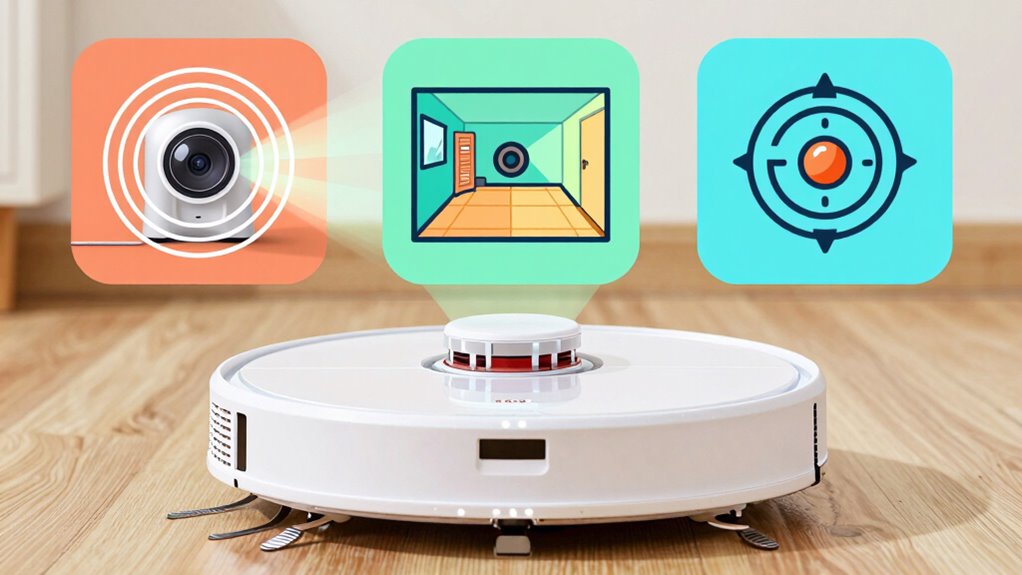
Have you ever wondered how robot vacuums navigate so efficiently around your home? Gyroscopes play a vital role by providing orientation data that helps the vacuum keep track of its movements. They work alongside motion sensors to detect changes in direction and speed, feeding this information into navigation algorithms. This combination allows the robot to:
Gyroscopes help robot vacuums track movement and navigate smoothly around your home.
- Maintain a sense of direction even when visual cues are limited.
- Detect when it’s turning or moving in a new area.
- Correct its path if it gets off-course.
- Enhance navigation accuracy by integrating data from other sensors to create a more reliable understanding of movement.
Gyroscopes don’t map your home but help the vacuum understand its rotation and position changes. This makes navigation smoother, more precise, and less likely to miss spots or get stuck.
Which Mapping Technology Is Best for Your Home?
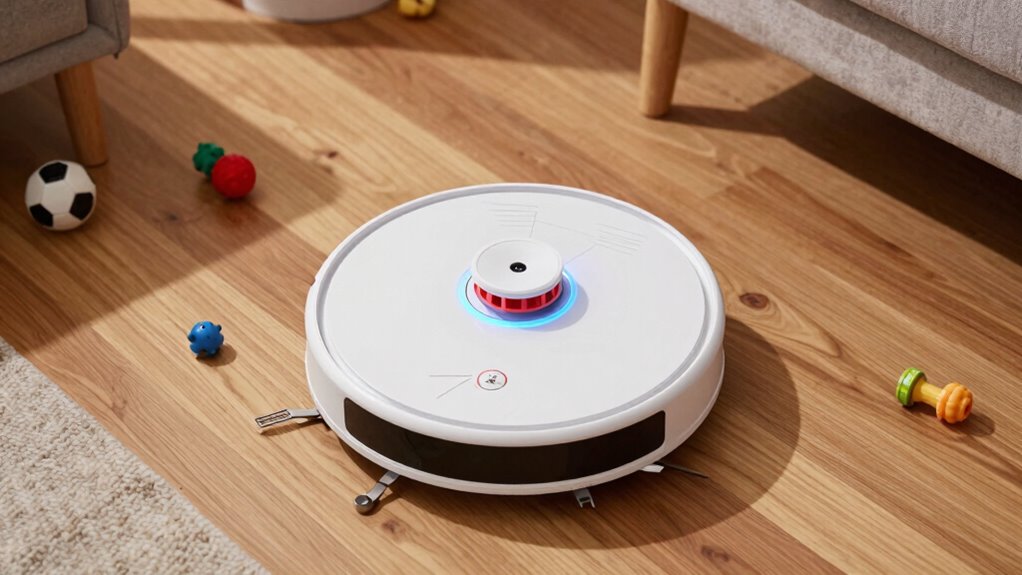
Choosing the right mapping technology can markedly improve your robot vacuum’s efficiency and cleaning coverage. If your home has complex layouts or tight spaces, a robot with lidar or advanced cameras provides precise mapping and obstacle detection. For homes with robotic arms or smart features like voice control, these technologies enhance navigation and responsiveness. Voice control allows you to direct your vacuum easily, while accurate mapping ensures thorough cleaning without missing spots. If you have pets or cluttered rooms, a system with lidar or camera-based mapping helps the vacuum adapt better. Consider your home’s size, furniture arrangement, and smart home setup. The best choice depends on how much detail and automation you want, but a well-mapped vacuum ultimately delivers a more efficient and satisfying clean. Additionally, mapping accuracy can significantly reduce the need for manual adjustments or repeated cleaning passes.
How Can I Check Which Mapping Tech My Robot Vacuum Uses?

Want to know which mapping technology your robot vacuum uses? Start by checking your user manual or product specifications online. You can also look for clues in the app that controls your device. Here are three ways to identify the tech:
Discover your robot vacuum’s mapping tech by checking the manual, app clues, or cleaning patterns.
- Check the product specs for mentions of Lidar, camera, or gyro sensors to assess mapping accuracy. Recognizing these features can give you a quick idea of the system’s capabilities.
- Visit the manufacturer’s website for detailed descriptions of the mapping system and device compatibility.
- Observe the cleaning pattern: precise, grid-like maps suggest Lidar, while camera-based models may rely on visual data, and gyro-only models tend to have less detailed maps.
- Pay attention to the mapping technology used in reviews or product descriptions to better understand its capabilities. Understanding the mapping technology can also help you troubleshoot issues or optimize your device’s performance. Additionally, researching sensor types in robotics can provide deeper insights into how these systems function.
Knowing your device’s mapping tech helps you understand its capabilities and limitations, ensuring better performance and compatibility.
Frequently Asked Questions
How Accurate Are Robot Vacuum Maps in Complex Home Layouts?
In complex home layouts, robot vacuum maps can be quite accurate, but their mapping precision varies. You might notice some errors around tight spaces, furniture, or obstacles. Higher-end models with advanced sensors, like lidar, tend to handle layout complexity better, providing more dependable maps. However, in highly intricate or cluttered homes, you should expect some minor inaccuracies, which might require manual adjustments or multiple cleaning passes for ideal coverage.
Can Robot Vacuum Maps Be Updated After Initial Setup?
Yes, robot vacuum maps can be updated after the initial setup. You just need to run a mapping update, which often happens automatically with software improvements or can be manually triggered through the app. These updates help the vacuum adapt to changes in your home, like new furniture or layout adjustments, ensuring your cleaning remains efficient and accurate over time.
Do Different Mapping Technologies Work Better on Certain Floor Types?
Like a knight with a trusty sword, your vacuum’s mapping tech adapts differently to each floor type. Lidar works well on hard surfaces like tile or hardwood, offering precise navigation with minimal material sensitivity. Cameras excel on carpets, but struggle with dark or reflective floors. Gyros are versatile but less accurate on uneven or textured surfaces. Choose your robot based on your floor type for ideal cleaning.
How Do Obstacles Like Pets Affect Mapping Accuracy?
Pet movement can temporarily confuse your robot vacuum’s obstacle detection, making it harder to create an accurate map. Fast or unpredictable pet movements might cause the vacuum to miss obstacles or misjudge their location. However, most modern vacuums adapt quickly, using sensors to detect obstacles and update the map on the fly. Regularly checking for pet-related interference helps make sure your vacuum maintains the best possible mapping accuracy.
Are There Privacy Concerns With Camera-Based Mapping?
Camera-based mapping can feel like having a neighbor peek through your window, raising camera privacy concerns. You might worry about data security, wondering where that visual data goes after your robot’s done cleaning. Manufacturers often claim they secure your information, but the idea of constant surveillance can leave a uneasy feeling. For peace of mind, check if your device has privacy features and transparent data security policies.
Conclusion
Understanding your robot vacuum’s mapping tech helps you choose wisely, guarantee efficiency, and enjoy a cleaner home. Whether it’s lidar to navigate precisely, cameras to see surroundings clearly, or gyroscopes to keep track of movement, each method offers unique advantages. By knowing how these technologies work together—by guiding, detecting, and orienting—you can better appreciate your vacuum’s capabilities. Ultimately, selecting the right tech means smoother cleaning, smarter navigation, and a more spotless home.