
TL;DR

Get furniture and decor delivered free with Prime
- Fast, free delivery on millions of items
- Prime Video, Amazon Music and more included
- Member-only deals all year
A Hunker report outlines clear contact paper as an inexpensive alternative to curtains for adding window privacy while allowing light into a room. The adhesive covering can be cut slightly oversize, smoothed onto clean glass and trimmed; the report says it can be removed and leftover adhesive cleaned off.
Hunker has reported that clear contact paper can be applied to window glass as a lower-cost alternative to curtains, obscuring views into a room while allowing daylight through. The approach may suit small spaces such as bathrooms, where curtains can add visual bulk, though the report does not provide comparative prices or independent testing of privacy performance.
The method uses clear contact paper, a self-adhesive covering more commonly used on flat surfaces such as shelves and cabinet interiors. Hunker says it gives glass a frosted appearance that limits the view inside without blocking all incoming light. People seeking more coverage can choose patterned or solid-color contact paper, or use a stained-glass-style design; these options may also reduce the amount of light that passes through.
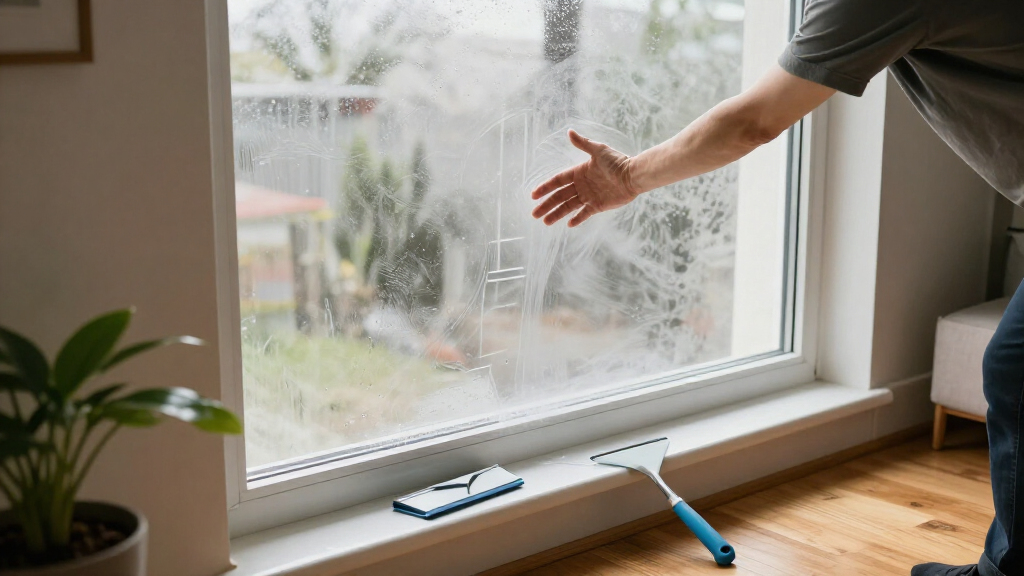
For installation, the report recommends cleaning the window first, then applying the paper and smoothing it as it goes on. A wallpaper smoother can push out air bubbles; a credit card or nylon pan scraper is offered as an alternative. The material can be cut a little larger than the glass and trimmed after application with a utility knife, which helps avoid uncovered gaps at the edges.
Hunker says contact paper is generally less expensive than static-cling window film, particularly when a larger amount is needed, and that its adhesive may hold better in humid rooms such as bathrooms. It also says the covering is removable, with soap and water or a product such as Goo Gone Adhesive Remover Spray Gel suggested for remaining adhesive. These are the report’s guidance and product claims; it does not specify costs, brands tested, or how removal may affect every type of glass or finish.
Privacy Without Curtains
The approach offers renters and homeowners another way to address street-facing or overlooked windows without installing a curtain rod or adding fabric to a compact room. Because the covering sits directly on the glass, it may be useful where curtains would crowd a bathroom or other small space. Its main trade-off is that it changes the window itself: unlike a curtain, the covering cannot be pulled aside to restore an unobstructed view.
Cost and light control will depend on the chosen material and how much glass is covered. Clear, frosted-style paper is intended to let light through, while colored or opaque patterns can block more. Hunker describes the method as budget-friendly but gives no price comparison, so buyers should check the cost of the required roll against window-film and curtain options before deciding.
Products Worth Considering

Dyson Car+Boat Cordless Handheld Vacuum

eufy Security Essential 7-Piece Alarm System

Dyson Airwrap i.d. Multi-Styler for Straight and Wavy Hair
As an affiliate, we earn on qualifying purchases.
How the Window Covering Works
Curtains are a familiar way to add privacy and decoration, but Hunker notes that buyers have to weigh size, style and care, as well as cost. The report presents contact paper as one alternative to both curtains and static-cling film. Unlike cling film, it attaches to glass with adhesive, a feature Hunker says can help it stay in place in a humid bathroom.
The idea adapts a material used on other smooth surfaces for a window application. Hunker mentions plain clear covering, lace and diamond patterns, striped layouts made by cutting the paper into strips, and stained-glass designs. The report does not frame these as tested products or provide a formal comparison of durability, visibility from different angles, or long-term performance.
“A much more budget-friendly way to add privacy to your windows, while still letting in light, is to skip the curtains entirely and apply clear contact paper directly to the glass.”
— Hunker report
Costs and Privacy Limits
The supplied report does not give specific prices, a measured savings figure, or the window sizes used for comparison with curtains and static-cling film. It also does not quantify how much privacy the material provides under different lighting conditions. A frosted appearance may obscure a view, but the report offers no tests of visibility from indoors or outdoors, especially at night when lights are on inside.
Other practical details remain unspecified, including how long the adhesive lasts, whether it leaves residue on every glass type, and whether the covering affects window warranties or coatings. The source also does not identify a safety or product standard for contact paper used on windows. Readers should check the product’s own instructions and suitability for their particular glass before applying it.
Check the Glass Before Applying
There is no announced product launch or scheduled follow-up in the source material. For anyone considering the method, the next step is to measure the window, compare the price of enough contact paper with other treatments, and review the product instructions for use on glass. Applying a small test section first may help reveal how the material looks and whether removal leaves residue on that window.
During installation, clean and dry the glass, smooth the covering to limit bubbles, and trim excess carefully. If the goal is privacy after dark, check the view from outside with interior lights on rather than relying only on the daytime appearance. Those checks address questions the Hunker report does not resolve and can help determine whether a removable adhesive covering meets the room’s needs.
Key Questions
Does clear contact paper block all light?
No. Hunker describes clear contact paper as creating a frosted look that obscures the view while allowing light to filter through. The report does not give a measured light-transmission rate.
How is contact paper applied to a window?
Clean the glass, apply the paper while smoothing out bubbles with a wallpaper smoother or card, then trim the extra material with a utility knife. Hunker recommends cutting slightly larger than the glass rather than leaving gaps.
Is contact paper cheaper than window film?
Hunker says it is usually less expensive than static-cling window film, especially for larger quantities. The report gives no prices or product-by-product comparison.
Can the covering be removed?
Hunker says it can be removed and suggests soap and water or an adhesive-removal product for residue. It does not report how removal performs on every type of glass or coating.
Will it provide privacy at night?
The source does not test nighttime privacy. Check the window from outside after dark with the room lights on, since the report provides no visibility measurements for those conditions.
Source: hunker.com