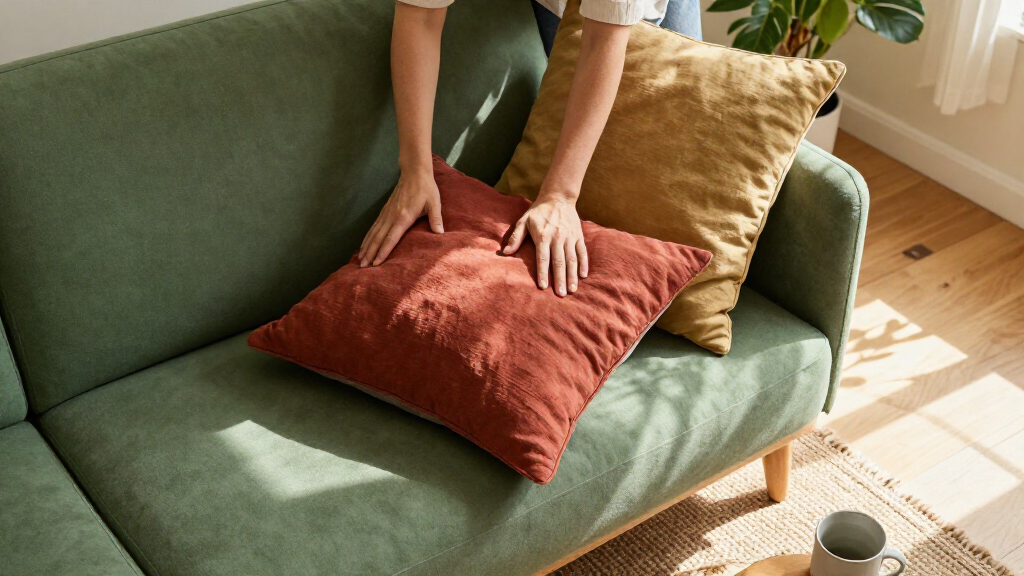

Choosing designer throw pillow covers often comes down to a practical style decision: do you want the relaxed texture of linen or the plush color and softness of velvet? Both can make a sofa or bed feel more considered, but they behave differently in daily use. Linen tends to suit casual, layered rooms and warm weather; velvet brings visual depth and a polished finish, especially in cooler seasons or more formal spaces. The best choice depends on how the room is used, how much upkeep you accept, and whether texture or softness matters more.

Get furniture and decor delivered free with Prime
- Fast, free delivery on millions of items
- Prime Video, Amazon Music and more included
- Member-only deals all year

The Camille Floral Block Print Pillow Cover, Soft Blue and White, 20 x 20 Inches
- ✔ Material: Polycotton blend
- ✔ Dimensions: 20 x 20 inches
- ✔ Pattern: Soft blue floral block print

Ridhi Asparagus Green Block Print Cotton Pillow Covers, 18 x 18 Inches, Set of 2
- ✔ Material: 100% cotton
- ✔ Dimensions: 18 x 18 inches each
- ✔ Quantity: Set of 2

VAGMINE Marbled Feather Print Throw Pillow Cover, 18 x 18 Inches
- ✔ Material: 100% woven polyester
- ✔ Dimensions: 18 x 18 inches
- ✔ Pattern: Marbled feather with multicolor plumes
At a Glance
| Criteria | Designer linen throw pillow covers | Designer velvet throw pillow covers | Winner |
|---|---|---|---|
| Look and texture | Matte, visibly woven texture with a relaxed, natural character. | Soft pile with a subtle sheen that can look rich and tailored. | Depends |
| Comfort and seasonal feel | Breathable and cool to the touch; can feel crisp rather than plush. | Plush and cozy, making it inviting in cooler weather; may feel warm in summer. | B |
| Durability for everyday use | Strong fibers can hold up well, though the weave may snag or show wear. | Can be durable, but pile can crush, mark, or show pressure and pet hair. | Depends |
| Care and maintenance | Often easier to spot clean, but washing instructions vary and linen can wrinkle or shrink. | Usually benefits from gentle spot care; some covers require professional cleaning. | A |
| Color and pattern impact | Muted, earthy colors and weave variations are common; texture adds interest without shine. | Saturated colors look deep and dimensional; pile direction can shift the apparent shade. | B |
| Styling versatility | Works especially well in casual, coastal, rustic, and contemporary rooms. | Strong in formal, glam, traditional, and jewel-tone schemes; balances smoother fabrics. | A |
| Typical price and value | Quality covers can cost more than basic cotton, with value in texture and natural-fiber appeal. | Designer velvet can command a premium; the added cost pays off most when softness and color depth matter. | Depends |
The Camille Floral Block Print Pillow Cover, Soft Blue and White, 20 x 20 Inches
The Camille is our best overall choice because it combines a recognizable designer look with details that keep the cover easy to place. Its soft blue floral block print sits on white, and blue-grey piping frames the square shape. The same pattern appears on both sides, so the cover still looks finished when a pillow shifts on a sofa or bed. Compared with VAGMINE’s multicolor marbled feather, Camille is more restrained and easier to coordinate with a room built around blue, white or pale neutrals.The 20-inch size also sets it apart from the two 18-inch options in this lineup. That extra scale can help it read as a main accent on a bed or larger sofa, though it will not suit an existing 18-inch insert as directly. The listing says it can be paired with a 20-inch insert or a 22-inch insert for a fuller look; inserts are sold separately. A concealed zipper keeps the edge neat, while the polycotton fabric offers a middle ground between VAGMINE’s all-polyester construction and Ridhi’s 100% cotton feel.We’d choose Camille for a polished cottage or grandmillennial arrangement, especially when one larger floral pillow needs to tie together solid cushions. Its classic palette and tailored finish make it the most flexible single cover here. The tradeoff is that buyers seeking natural-fiber texture will find Ridhi more appealing, and those wanting vivid, room-dominating color may prefer VAGMINE. The product information identifies the fabric as polycotton but gives no detailed care instructions, so we would check the care label before cleaning.
Pros:
- Double-sided soft blue floral print
- Blue-grey piping gives the square a defined edge
- 20-inch cover can suit larger sofa and bed arrangements
- Concealed zipper for a clean finish
Cons:
- Insert is sold separately
- Larger size may not fit existing 18-inch inserts
- Detailed washing instructions are not provided in the supplied listing
Best for: Shoppers who want one larger, double-sided floral accent for a cottage, chinoiserie or grandmillennial room.
Not ideal for: Buyers committed to natural cotton, or anyone who needs an 18-inch cover for an existing insert.
Bottom line: Choose The Camille for the most balanced mix of classic pattern, polished edging and larger-pillow presence in this comparison.
“Choose The Camille for the most balanced mix of classic pattern, polished edging and larger-pillow presence in this comparison.”
Ridhi Asparagus Green Block Print Cotton Pillow Covers, 18 x 18 Inches, Set of 2
Ridhi’s set of two solves a different styling problem from The Camille: it gives us a matching pair, rather than one larger statement cover. The asparagus-green floral block print and 100% cotton fabric suit farmhouse, boho and cottage rooms where a softer, more relaxed finish feels at home. The set can anchor both ends of a sofa or create a coordinated bed arrangement without requiring us to find a second cover in a compatible pattern.Both covers measure 18 x 18 inches, the same size as VAGMINE’s single cover, so they suit shoppers building around standard square inserts. The listing specifies an envelope closure rather than the concealed zippers on Camille and VAGMINE. That gives the back a simpler construction, but it may feel less secure or tailored to shoppers who prefer a zipper. The listing also describes the cotton as breathable and identifies the print as hand block print; those details point to a more tactile, craft-inspired look than the smoother, printed-polyester style of VAGMINE.Ridhi’s strongest advantage is the combination of natural fabric and two-cover coordination. It is the sensible choice when a room needs a pair of complementary accents, while Camille is more compelling for one larger, refined floral focal point. The green palette is also more specific than Camille’s blue-and-white combination, and less exuberant than VAGMINE’s multicolor print. The supplied details call the covers fade-resistant and shrink-resistant but do not include washing instructions or clarify whether inserts are included; check the package details before ordering and care.
Pros:
- Set of two makes a coordinated arrangement straightforward
- 100% cotton offers a natural fabric feel
- 18-inch size matches VAGMINE’s format
- Hand block-print style adds a relaxed decorative character
Cons:
- Envelope closure is less tailored than the zipper closures on the other picks
- Asparagus-green floral palette may be harder to pair with some rooms
- Supplied listing does not specify care instructions or insert inclusion
Best for: Buyers who want two matching 18-inch cotton covers for a farmhouse, boho or cottage seating arrangement.
Not ideal for: Shoppers who need a zipper closure, a single oversized accent, or a more formal, sharply tailored finish.
Bottom line: Pick Ridhi when a pair of natural-cotton covers matters more than zipper closure or a single dramatic focal point.
“Pick Ridhi when a pair of natural-cotton covers matters more than zipper closure or a single dramatic focal point.”
VAGMINE Marbled Feather Print Throw Pillow Cover, 18 x 18 Inches
For a room that needs color rather than another quiet neutral, VAGMINE’s marbled feather print is the most expressive choice in this group. Swirling multicolor plumes fan across a cream polyester ground, with sage piping outlining the square. The design is printed on both sides, so the pattern remains visible from different angles. Compared with Camille’s orderly blue floral and Ridhi’s softer green block print, this cover makes a stronger visual statement and will likely set the palette for the cushions around it.At 18 x 18 inches, VAGMINE matches Ridhi’s dimensions, but it is sold as one cover rather than a set of two. That makes it useful when we want a single accent among solids or a complementary pair assembled from different designs. The concealed zipper gives it a more tailored closure than Ridhi’s envelope back. Its woven polyester has a soft hand-feel according to the listing, and the care directions are unusually clear: machine wash cold on a gentle cycle, inside out, then line dry.We rank it third because its vivid marbling is less adaptable than Camille’s classic floral, and the polyester fabric will not suit shoppers specifically seeking the natural texture of Ridhi’s cotton. Those are meaningful tradeoffs, not flaws for every room: maximalist, eclectic and transitional spaces may benefit from exactly this level of color. The cover is sold without an insert, so buyers should account for that and confirm they have an 18-inch cushion to fill it. Choose it when pattern is the point; skip it when you need a quiet, easy-to-repeat foundation.
Pros:
- Multicolor marbled feather print creates a clear focal point
- Printed on both sides
- Sage piping and concealed zipper give it a finished edge
- Cold gentle machine-wash and line-dry directions are specified
Cons:
- Vivid print may dominate a restrained room
- Polyester lacks the natural-fiber character of Ridhi’s cotton
- Sold as one cover with insert not included
Best for: Shoppers who want one colorful, double-sided accent for a maximalist, eclectic or transitional room.
Not ideal for: Those seeking a subdued pattern, natural cotton, or a coordinated pair in one package.
Bottom line: Choose VAGMINE when a single vivid accent and easy-to-follow care directions outweigh the versatility of a quieter print.
“Choose VAGMINE when a single vivid accent and easy-to-follow care directions outweigh the versatility of a quieter print.”
As an Amazon Associate we earn from qualifying purchases.
Key Differences
The strongest distinction is the surface. Linen shows its weave and gives a room a softer, less polished look. Velvet reflects light across its pile, so the same color can appear deeper or shift with the direction of the fabric. That makes velvet more dramatic, while linen blends more quietly with other furnishings. The difference is moderate to major depending on whether the pillows are meant to anchor the room or support an existing scheme.
Daily comfort and upkeep also point in different directions. Linen is generally cooler and more breathable, while velvet feels warmer and more cushioned. Linen may wrinkle, and its open texture can catch on claws or rough surfaces. Velvet can retain impressions and attract lint or pet hair, and care may be more demanding. Check each cover’s fiber content, closure, and care label: designer fabrics vary, and the fabric name alone does not promise a particular cleaning method.
For value, neither material wins in every room. Linen is often the more versatile purchase if the covers will stay on frequently used seating and need to work across seasons. Velvet earns its premium when its softness, saturated color, or polished appearance is a key part of the room. Paying more for a designer label makes sense only when the construction, fabric quality, and finish justify it for your use.
Detailed Comparison
Look and texture (major difference)
Linen wins for an understated, tactile look; velvet wins for sheen and visual richness. This is a major stylistic gap: linen recedes into a casual palette, while velvet makes the pillow a focal point. Choose based on whether you want quiet texture or a more dressed-up accent.Comfort and seasonal feel (Designer velvet throw pillow covers wins — moderate)
Velvet wins for softness and a cozy hand, while linen feels cooler and more breathable. The difference is moderate in a climate-controlled room, but more apparent in hot summers or when pillows are used for lounging. Linen suits year-round use in warm rooms; velvet feels more inviting in cooler spaces.Durability for everyday use (minor difference)
Neither material is universally tougher. Linen fibers can be sturdy, but the weave may snag; velvet can wear well, but the pile may crush or reveal marks. The gap is minor without details about fiber, weave, and construction. For a busy home, compare fabric specifications and removable-cover care rather than relying on the material name.Care and maintenance (Designer linen throw pillow covers wins — moderate)
Linen has the edge for straightforward upkeep in many designs, while velvet often calls for more careful handling to preserve its pile. The difference is moderate, although exact labels matter: some linen shrinks or needs dry cleaning, and some velvets are washable. For homes with frequent spills, buy according to the listed cleaning method.Color and pattern impact (Designer velvet throw pillow covers wins — moderate)
Velvet wins for saturated color and light-catching depth; linen favors subtle color variation and woven texture. The gap is moderate to major when the pillows carry the room’s accent color. Velvet creates a richer focal point, whereas linen layers easily with prints and natural materials.Styling versatility (Designer linen throw pillow covers wins — moderate)
Linen wins for broad everyday versatility, pairing easily with cotton, wool, leather, and patterned covers. Velvet can also mix well, but its polish and visual weight make it more noticeable. This is a moderate advantage for linen if you rotate pillows or change decor seasonally.Typical price and value (moderate difference)
There is no automatic value winner: both designer linens and velvets span a wide range. Linen is often a safer value for frequent, year-round use; velvet is worth paying more for when its plushness and color depth are central to the look. Compare fiber content, finishing, and care requirements before paying a label premium.Designer linen throw pillow covers: Pros and Cons
Pros:
- Breathable feel that works well in warm rooms and across seasons.
- Natural woven texture layers easily with other fabrics.
- Often a practical choice for relaxed, frequently used spaces.
Cons:
- Can wrinkle and may feel crisp rather than soft.
- Open weaves can snag, depending on construction and household use.
- Care instructions vary; some covers can shrink or require special cleaning.
Designer velvet throw pillow covers: Pros and Cons
Pros:
- Soft, plush surface feels cozy and looks polished.
- Rich colors gain depth from the pile’s subtle sheen.
- Can add a strong accent to formal or tailored interiors.
Cons:
- Pile may show pressure marks, crushing, lint, or pet hair.
- Can feel warm in hot weather.
- Care may be more demanding, depending on fiber and construction.
Who Should Choose What
Choose Designer linen throw pillow covers if:
- You want breathable covers for a warm room or year-round use.
- Your decor is casual, natural, coastal, or layered with woven textures.
- You expect to use the pillows often and prefer a relaxed finish.
Choose Designer velvet throw pillow covers if:
- Softness and a cozy hand matter more than a cool feel.
- You want a saturated accent color or a more polished room.
- The covers are decorative accents and you can follow gentler care instructions.
Skip both if: Skip both if the pillows will face frequent spills, rough outdoor use, or heavy pet contact and neither cover’s care label and fabric construction suit that workload; look for a performance fabric designed for those conditions.
Value for Money
Price alone does not settle the choice: designer covers in either fabric can vary widely by fiber, construction, finish, and maker. Linen usually offers better everyday value when you want one set to work across seasons and with changing decor. Velvet is worth paying more for when its softness or deep, light-shifting color is a feature you will notice every day. Before buying, compare the listed fiber content, closure, insert fit, and cleaning instructions. A premium label does not compensate for a fabric that clashes with your use or care routine.
Final Verdict
Choose linen for the more adaptable everyday cover: it is breathable, easy to layer, and suits relaxed rooms. Choose velvet when you want a softer, richer accent and are comfortable giving the pile more careful attention. The biggest deciding factor is how the pillows will be used: for frequent lounging in a warm or casual space, linen is the stronger default; for a cooler room where color and plushness lead, velvet earns its place. Pay more for velvet only when that finish is central to the look, and check the specific care label before either purchase.
Frequently Asked Questions
Are linen or velvet throw pillow covers better for everyday use?
Linen is often the more practical everyday choice because it feels breathable and has a relaxed finish. Velvet can also work daily, but its pile may show pressure, lint, or wear. Check the specific fabric and care instructions before deciding.
Which designer pillow cover is easier to clean?
Linen often has the simpler care routine, but not always. Some linen covers shrink or require dry cleaning, while velvet covers may need gentle spot care. The care label for the exact cover is the best guide.
Is velvet worth paying more for?
It can be if you want a plush feel, a polished look, or rich color that becomes a focal point. If you need versatile covers for frequent use, linen may deliver better value for the money.
Do linen and velvet pillow covers work together?
Yes. Pairing them creates a useful contrast: linen adds a matte woven texture, while velvet brings softness and sheen. Keep colors related or balance one strong velvet accent with quieter linen covers.