
Get furniture and decor delivered free with Prime
- Fast, free delivery on millions of items
- Prime Video, Amazon Music and more included
- Member-only deals all year
A room designed around what you can’t hear
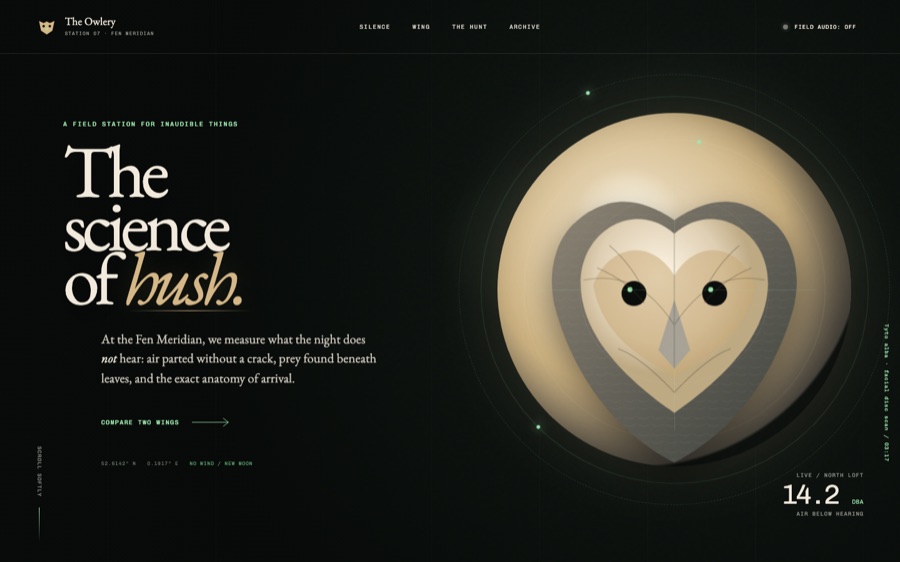
The Owlery is an AI-built exhibition piece: a fictional field station exploring the real acoustic adaptations that help owls fly quietly. It is not a real institute or company. Presented like a nocturnal research room, the experience borrows the mood of a naturalist’s study and the precision of a sound laboratory.
Its signature move is to make silence feel like the main event. A visitor compares two flight traces: a jagged, noisy pigeon waveform and an owl waveform that settles into a nearly level line. The display lets that quiet line take over the screen. The pause isn’t leftover space; it is the room’s dramatic centerpiece.
Products Worth Considering

Sonos One SL (3-Pack) – Microphone-Free Speaker, Black

Hisense 55-Inch E6SR Series 4K UHD Hi-QLED Roku Smart TV (2026 Model)

Google Nest Learning Thermostat Pro Edition (4th Gen, 2024) with Temperature Sensor, Polished Silver
As an affiliate, we earn on qualifying purchases.
Inside the visual and interactive design
The palette shifts between spectrogram black, warm owl buff, moon white, muted talon grey, and a restrained signal green. Dark passages give the room a sense of night; buff-colored fields feel like a lamp has illuminated a specimen table. That alternating light and shadow encourages the eye to adjust as it moves through the exhibition.
Typography reinforces the contrast. EB Garamond gives the editorial labels and observations a naturalist’s character, while Chivo Mono handles measurements and instrument language. The serif invites lingering; the monospaced face makes information feel observed and recorded.
Rather than relying on photographs or generated imagery, the exhibition builds its visual world from SVG and CSS: feather anatomy, an owl, a moon, bones, leaf litter, acoustic paths, scanlines, and grain. The code-built surfaces make the interface feel less like a gallery of pictures and more like a set of carefully arranged specimens and instruments.
Silence as an interaction
The comparison instrument stages its result over time: first the pigeon trace, then the owl trace, followed by a 4.8-second hold in which a luminous dash expands into the verdict. The quiet state gets the longer pause, allowing absence to register as something visible.
A separate stillness test makes the visitor part of the experiment. Movement interrupts the countdown; remaining still lets it resolve to a reading of 0.00 Pa. The page also includes a feather microscope with selectable adaptations and a keyboard-operable sound-localization exercise. Audio is off unless the visitor opts in, and motion-sensitive settings provide a quieter alternative. These details give the room the texture of an instrument panel without losing its sense of wonder.

From build to certification
The project followed a three-pass pipeline: build the exhibition around one measurable absence, critique it mercilessly for clarity, accessibility, and visual coherence, then send it through art-director certification. The accompanying construction guide documents the decisions behind the code-drawn specimens, comparison instrument, interaction behavior, and design tokens—so the room can be understood as a designed system, not just a finished scene.
The full build notes live in the room’s design guide.
Want this? Paste this into your AI coding agent
Build a single-page showcase website from this art-direction brief. Work like an elite creative frontend engineer; commit totally to the direction.
BRIEF (room 159 of 175, “owlery”):
OWLERY — THE OWLERY, a silent-flight research station (fictional station, real owl acoustics). Aesthetic: barn-owl buff against spectrogram black; science of hush. Palette: owl buff, moon white, spectrogram green on black, talon grey. Fonts: eb-garamond (display), chivo-mono (spectrograms). SIGNATURE: SILENCE COMPARED — the centerpiece: a pigeon’s wingbeat and an owl’s rendered as parallel sound-ribbon waveforms — the pigeon’s chops; the owl’s runs FLAT (silence made visible; the page holds on that flatness). Then the zoom: leading-edge serrations, velvet dorsal pile, trailing-edge fringe (SVG micro-anatomy, each labeled with the turbulence it kills). THE HUNT: an ear-asymmetry sound-localization interactive — triangulate a mouse under leaf litter by two offset “ears” (visual cones; synth rustle behind switch) and strike. Facial disc as parabolic dish diagram, pellet dissection inventory, invented station ring-codes. Unforgettable: seeing silence as a flat line.STACK: pure HTML/CSS/JS, no build step, no frameworks, no CDNs or external requests of any kind; self-hosted fonts only; every visual is code (CSS/SVG/canvas/WebGL) — no image assets required.
QUALITY BAR: flawless at 390px, 834px and 1440px with zero horizontal overflow; tap targets >= 44px; semantic landmarks, focus-visible styles, body-text contrast >= 4.5:1; prefers-reduced-motion pauses or simplifies heavy animation; rAF loops pause when the tab is hidden; hold 60fps (cap particle counts, avoid layout thrash); rich invented content everywhere — real-sounding names, numbers and program notes, never lorem ipsum; orchestrate one beautiful staggered load moment plus scroll and hover surprises. FORBIDDEN: Inter/Roboto/Arial/system-ui, purple-gradient-on-white, and cookie-cutter hero+cards+footer layouts.
PROCESS: iterate in three documented passes — (1) build plus builder self-critique, (2) merciless external critique finding and fixing at least ten real problems, (3) art-director elevation from good to unforgettable. Screenshot at all three widths every pass and fix everything you can see.
— Original brief by Claude Fable 5 (art director), executed by the FABLE/175 pipeline.
— This room lives at https://fable-25-830.netlify.app/sites/owlery/
This is the verbatim art-direction brief that produced the room — exposed by the exhibition itself via the “Prompt” link in the room’s footer.
Step into the Owlery
Visit the live Owlery room to see the silence comparison and explore its interactive instruments. Then browse all 175 rooms at the hub for more AI-built exhibition experiments.
Visit the live room → · Browse all 175 rooms
Previously in Wing VII
- Room 155: Luciole — The Synchronous Fireflies of Vallon Creux
- Room 152: Mothlight — A Porch-Light Census
- Room 154: Nightmarket — Mercado de Medianoche
FABLE / 175 is a finished exhibition of 175 fundamentally different websites, each built end-to-end by an AI. This article is part of our series walking through it room by room.